
Pizza, Cliffs, and a Vanished Uber: My Italian Coast-to-Rome Trip
By V.S. Journeys
The plan wasn't complicated: fly into Naples, rent a tiny car, spend three nights on the coast eating pizza and swimming in late-season sun, then drop the car, take a train to Rome, and play tourist for three more days. What I didn't plan for was standing outside my Rome apartment at 3:30am, watching an Uber icon sit motionless on a map while my cheap Ryanair flight home ticked closer to departure. But that came later. First, the pizza.
Pompeii and the Pizza That Ruined All Other Pizza
I landed in Naples on a Jet2 flight from London that cost roughly the same as a takeaway curry. The airport was humid and slightly chaotic, the kind of place where the queue for car rental moves at a pace that feels almost philosophical.
I'd booked the smallest vehicle available, and the agent handed me the keys to a Fiat Panda with an expression that suggested she'd seen enough tourists try to parallel park on the Amalfi Coast to know exactly what I was in for.
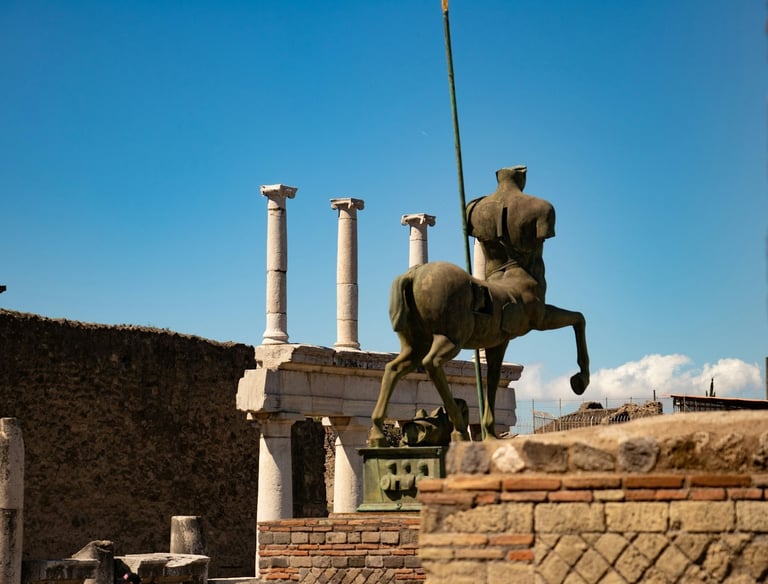
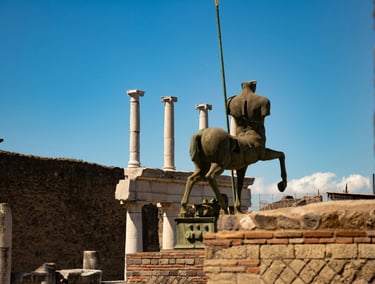
Pompeii was a thirty-minute drive. The site is enormous, far bigger than I'd imagined, and the audio guide I'd downloaded cut out after twenty minutes because I'd forgotten to charge my phone. So I wandered without narration, walking streets rutted by ancient carts, peering into houses where frescoes still clung to walls after two thousand years. The plaster casts of the victims — bodies curled, hands raised, faces frozen — stopped me cold. A child's small form, still wearing the shape of fear. A dog, twisted mid-strangle. I stood there long enough that a tour group flowed around me like water around a stone.
Afterwards, hungry and slightly raw, I drove to a pizzeria on the edge of modern Pompeii. It had plastic chairs and paper napkins and a wood-fired oven that had probably been burning since the Roman Empire.
The margherita arrived on a plate that was too small for it. The crust was blistered black in spots, soft and elastic inside. The sauce tasted of tomatoes that had actually seen sun. The mozzarella was fresh enough to weep, pooling slightly on the surface. I ate the whole thing in about four minutes, burned the roof of my mouth, and didn't care. It cost €5. I've thought about it weekly since.
The SS163 is not a road. It's a ledge with delusions of grandeur, hacked into a cliff face by someone who'd clearly never seen a car. It winds and tightens and occasionally reduces to a single lane just as a tour bus rounds the corner in the opposite direction. Driving it requires a peculiar blend of patience, spatial awareness, and a willingness to reverse around blind bends while local drivers gesture at you with a mixture of pity and disdain.
I loved it.
The key, I'd been told, is to rent the smallest car available. My Fiat Panda was essentially a motorised shoebox. It squeezed through gaps I'd have sworn were too narrow, and when a delivery truck forced me to reverse into a cliffside passing point, I only scraped the wing mirror once. A British couple in a rented SUV were not so fortunate. I passed them in Positano, the husband outside the car making wild hand gestures while his wife attempted a three-hundred-point turn on a 45-degree slope. They looked like they'd aged a decade. I waved sympathetically and kept driving.
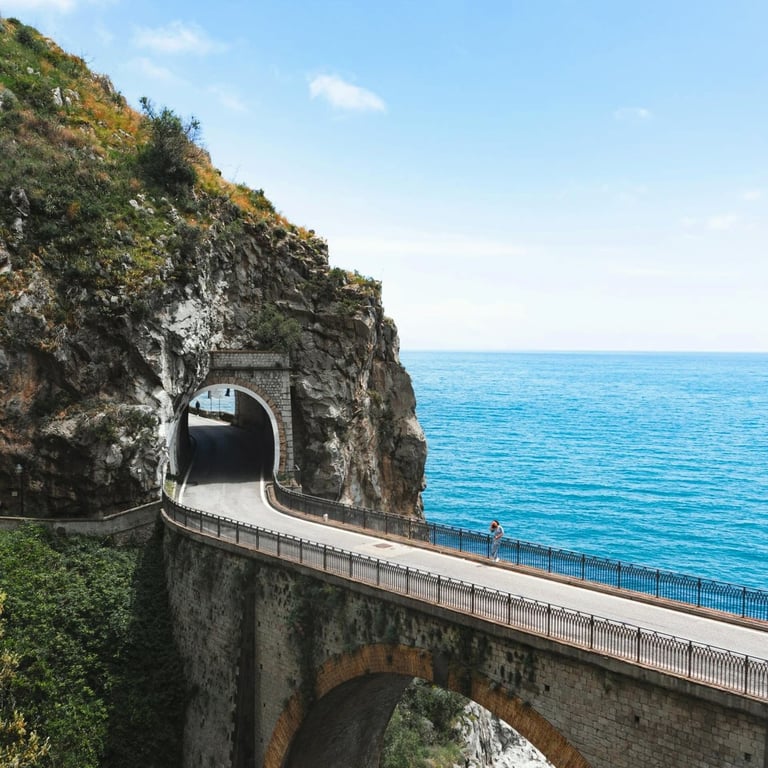
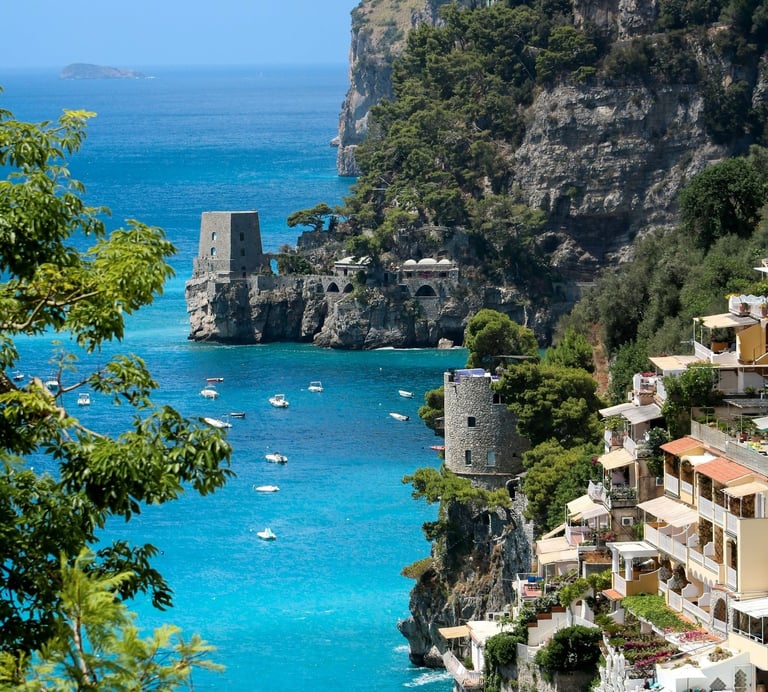
Positano appeared below me like a postcard someone had propped up against the mountainside — pastel houses stacked impossibly, tumbling towards a strip of grey pebble beach. I didn't stop. The parking situation was already desperate by 10am, even in early October, and I'd read enough horror stories about €10-an-hour cliffside garages to keep moving. Instead I pushed on to Amalfi town, found a multi-storey carved into the rock (€6 an hour, paid with a grinding sense of resignation), and walked down to the waterfront.
The beach was pebbled and quiet. The water was a deep, clear blue, and when I waded in, it was warm — maybe 23 degrees, the last gift of a long summer. I swam out past the moored boats and floated on my back, looking up at mountains that rose almost vertically from the sea. An old man fished from the pier with a hand line. A small dog barked at a seagull. The whole scene felt borrowed from a film.
I'd rented an apartment near Maiori for three nights. It was nothing fancy — terracotta floor tiles, a bed with a slightly concave mattress, a terrace that looked straight out at the Tyrrhenian Sea. The owners had left a bowl of lemons on the kitchen table. They were enormous, the size of softballs, and their scent filled the room. Each morning I'd make coffee in the tiny moka pot and sit on the terrace watching fishing boats drift through the morning haze. It cost €90 a night. I'd go back tomorrow.
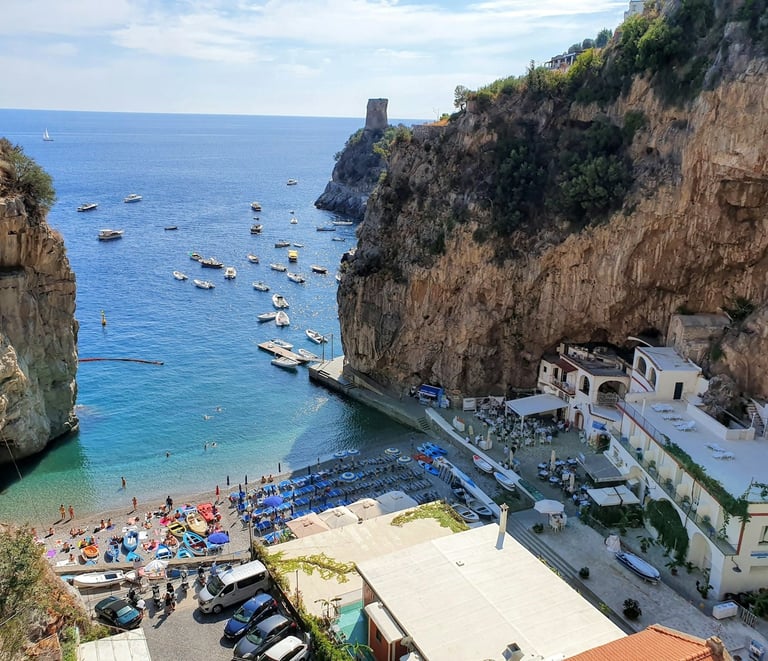
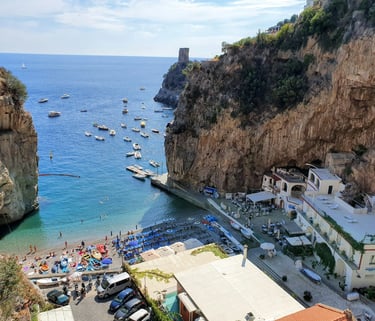
Parking, I should note, is a blood sport. Even in October, the shoulder season, finding a space required patience, creativity, and occasionally a willingness to park fifteen minutes' walk from where you wanted to be. One evening I wedged the Panda into a gap so tight I had to climb out the passenger door. A local woman watching from her balcony gave me a slow, approving nod. I felt absurdly proud.


The Train to Rome, or: How I Learned to Stop Worrying and Love Business Class
I returned the car to Naples airport, now wearing a fine film of coastal dust and a small scratch on the rear bumper I decided not to examine too closely. The agent glanced at it, shrugged, and waved me on. Italian car rental operates on a spectrum of relaxed indifference I found deeply comforting.
The high-speed train from Napoli Centrale to Roma Termini took 1 hour and 7 minutes. Business class — wide leather seat, complimentary coffee, a small biscotto wrapped in cellophane, the Italian countryside blurring past at 300 kilometres per hour — cost me €19. That's not a typo. I sat there sipping my coffee, watching Campania become Lazio, and marvelled at a country where a train ticket costs less than a cocktail but makes you feel like a minor dignitary. By the time we pulled into Termini, I was almost disappointed. I could have sat there all day.
Rome: Buses, Crowds, and a Dome Open to the Sky
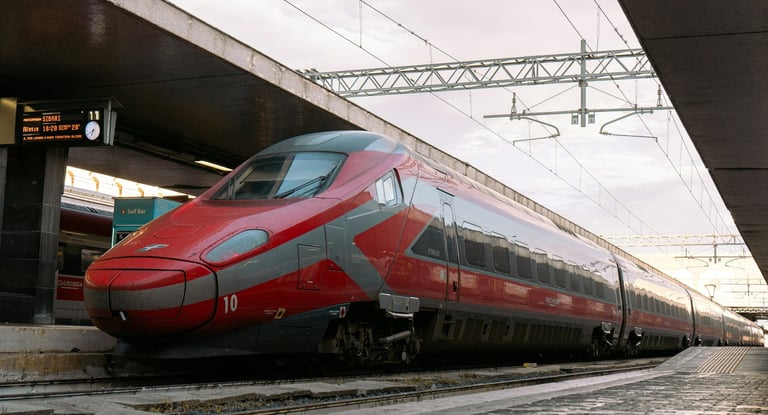
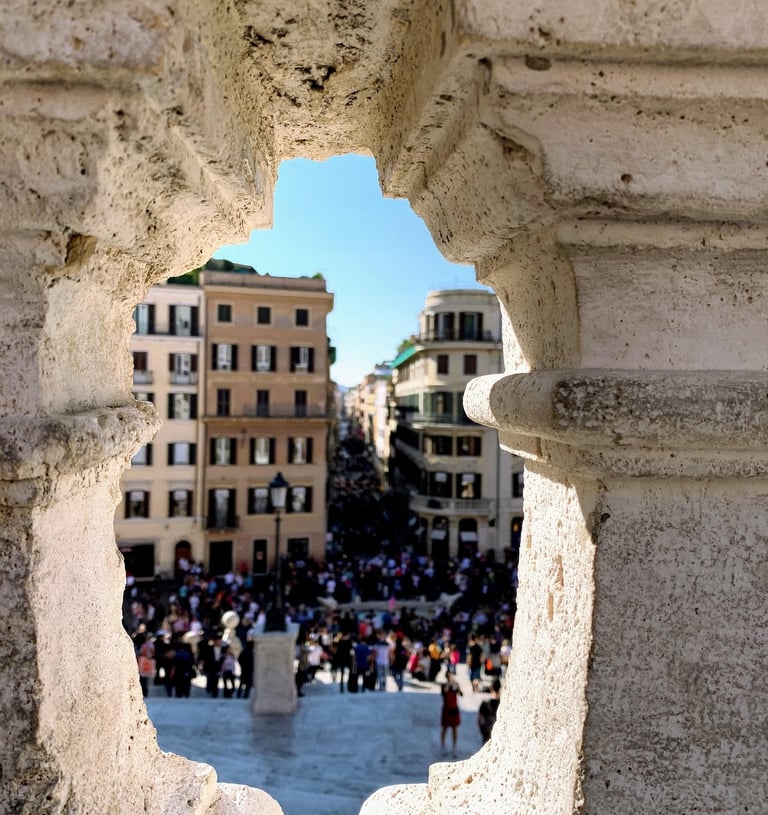
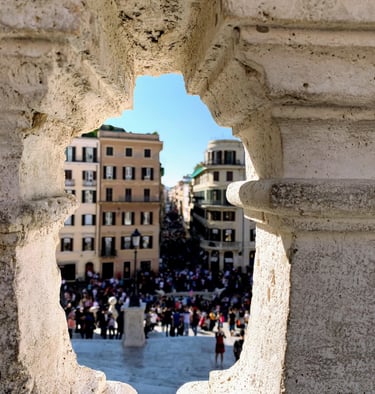
Rome in early October was supposed to be manageable. The weather was perfect — 25 degrees, a slight breeze that carried the smell of chestnuts from a street vendor's cart. But the Spanish Steps were a solid mass of humanity.
I walked up from the Spagna metro and found myself in a sea of people, phones held aloft, a man trying to press a rose into my hand while another waved selfie sticks like a conductor. I handed the rose back with more firmness than I felt, muttered "no, grazie" for the fourth time, and escaped into a side street where a small gelateria with a faded awning sold me pistachio gelato in a paper cup. It was olive-green, not neon, and tasted of nuts and salt and something I couldn't name. I stood in the shade of a shuttered doorway, eating it slowly, while the noise of the crowds faded to a distant hum. That became my Rome strategy: find the thing worth seeing, endure the crush, then disappear into a side street and eat something.
I'd booked a two-day hop-on-hop-off bus pass for about €32. It felt deeply uncool. But Rome's landmarks are spread across a city that's larger than you think, and the bus connected the Colosseum to the Vatican to Trastevere in a loop I could rely on. The open top deck gave me sunburn and a view of the city's rooftops I wouldn't have found on the metro. Was it stylish? No. Did it save me four hours of walking in 25-degree heat? Absolutely.
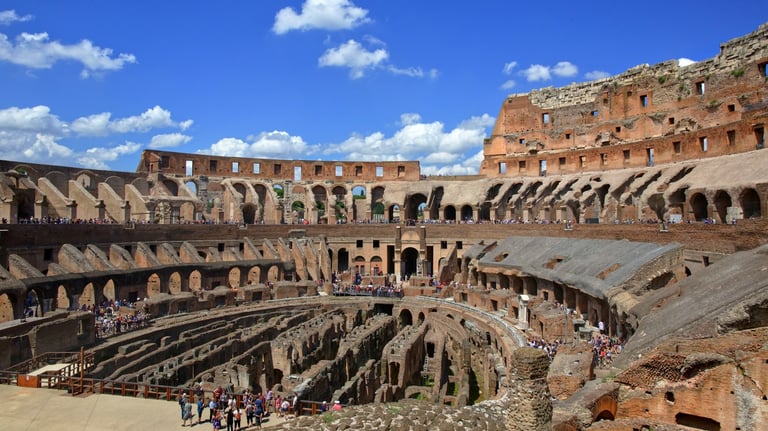
The Colosseum was first. Inside, the amphitheatre rose around me in tiers of ancient brick and travertine. I stood on the upper level, trying to imagine 50,000 people screaming as men and animals died below, and couldn't quite bridge the gap between that reality and the modern families eating focaccia in the stands, their children playing on iPads. The Roman Forum next door was quieter. I wandered through the ruins of temples and basilicas, past fallen columns where cats dozed in patches of sun. The scale of it — not just the buildings but the ambition behind them — was humbling.
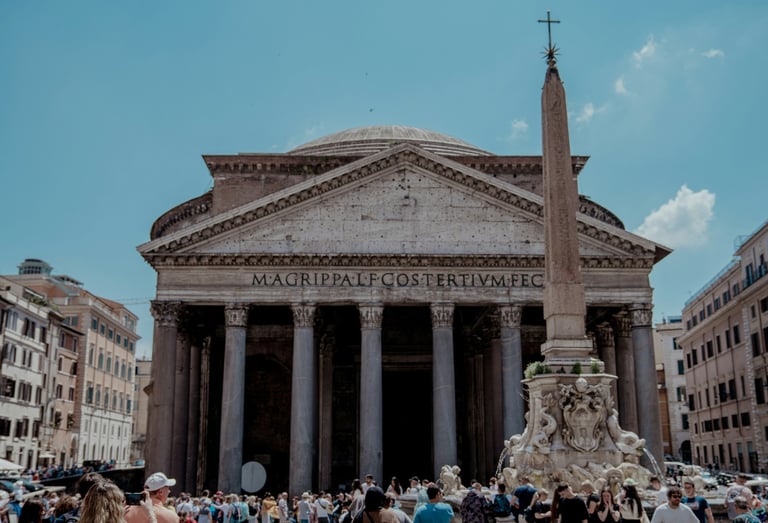
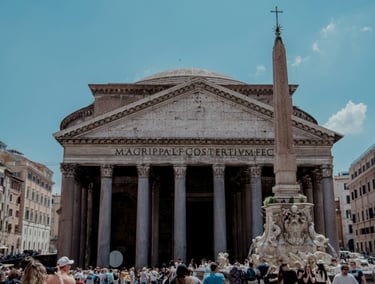
The Pantheon stopped me. Walking through those massive bronze doors and looking up at the oculus — a perfect circle of sky cut into the world's largest unreinforced concrete dome, nearly two thousand years old — I felt something shift. Rain had fallen earlier, and a few drops still pattered through the opening onto the marble floor, where small drains had been set to carry them away. An engineering solution from 125 AD, still working. I stood there for a long time, neck craned, while people streamed around me taking photos they'd never look at again. A small boy next to me tugged his mother's sleeve and asked, loudly, "Why is there a hole in the roof?" His mother shushed him. I wanted to tell him it was the best question I'd heard all day.
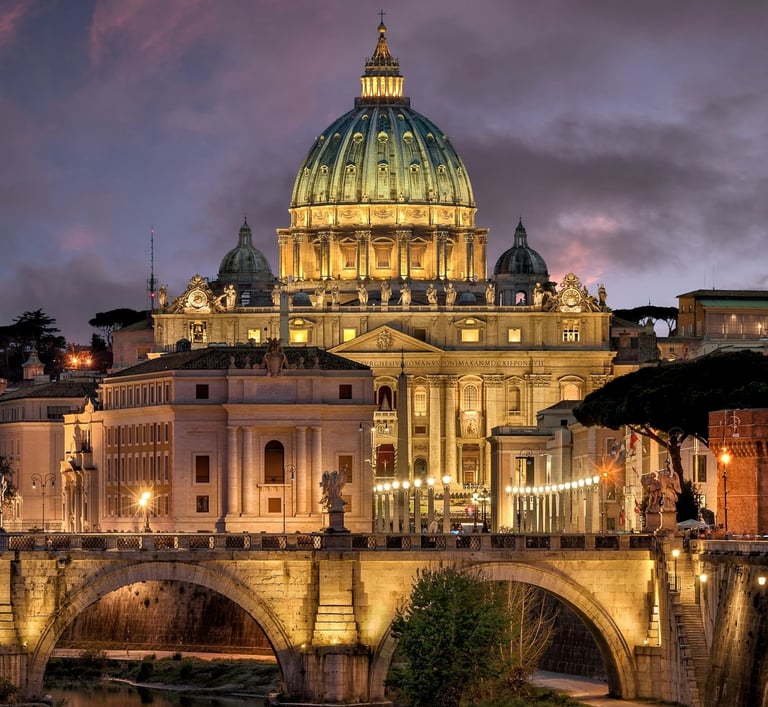
I crossed the Tiber one evening and got lost in Trastevere. The streets were so narrow my shoulders brushed walls on both sides. Fairy lights crisscrossed overhead. I ate saltimbocca in a trattoria where the waiter corrected my pronunciation of "saltimbocca" with such gentle despair I almost apologised. Afterwards I walked to Castel Sant'Angelo and looked out over the river as the city lights came on. A busker played something slow and sad on a guitar. The water caught the reflection of the illuminated dome of St. Peter's. For twenty minutes, Rome was quiet.
The Vatican consumed a day. St. Peter's Basilica is so vast it distorts your sense of scale — you walk towards the altar and it keeps receding, larger than your brain can process. The Vatican Museums were a human conveyor belt through gilded corridors until I reached the Sistine Chapel, where the ceiling was smaller than I'd expected and far more overwhelming. The figures strained and twisted, Adam's hand reaching towards God. No photograph captures it. I stood in the crush of silent tourists, all of us craning our necks like birds, until an announcement crackled over the speakers reminding us to move on. I left with a stiff neck and the strange feeling of having seen something too big to process in a single visit.
I skipped the Trevi Fountain entirely after hearing a fellow bus passenger describe it as "elbow combat." Some sights are worth queuing for. Others, I decided, could wait for a colder month and an earlier alarm.
3:30am: The Uber That Didn't Come
My flight home was from Rome Ciampino with Ryanair, booked for early morning. It cost £20, which was the problem — cheap flights come with brutal departure times. The night before, I checked bus timetables and train schedules. Nothing ran early enough. So I pre-booked an Uber.
At 3:30am I stood outside my rented apartment near Termini, bag packed, phone in hand. The app showed a driver assigned. The car icon sat motionless on the map. Five minutes passed. Ten. I called. No answer. The estimated arrival time ticked later and later. The icon didn't move.
With forty minutes until my gate closed, I started walking — half-running, really, my bag thumping behind me — towards a hotel I'd passed the day before. A minibus was idling outside, lights on. The driver leaned against the door, smoking.
"Ciampino?" I asked, slightly breathless.
He nodded. "Fifteen euro. Get in."
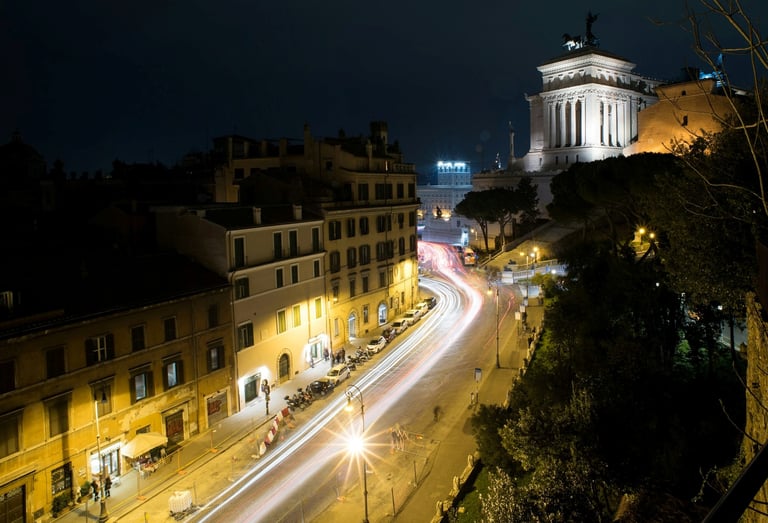
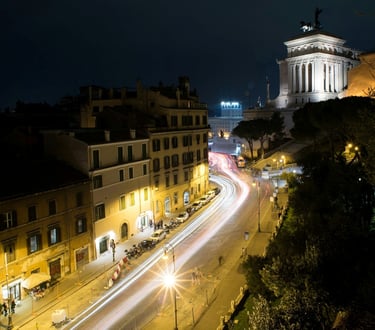
I climbed into a seat beside a French couple who were arguing in hushed, furious tones about whose fault it was that they'd booked an early flight. The minibus pulled away, and I watched Rome slide past the window — empty streets, shuttered bakeries, the Colosseum briefly visible in the distance, floodlit and silent. We made it to Ciampino with twelve minutes to spare. I handed the driver a €20 note, told him to keep the change, and joined the Ryanair queue, my heart still hammering.
The lesson, I suppose, is this: in Rome, a 3:30am Uber is a gamble. A hotel minibus is a guarantee. And a €15 shared ride with an arguing French couple is, in its own way, part of the trip.


I'd started this journey floating on my back in the warm Tyrrhenian, lemons the size of fists waiting on my terrace. I ended it sprinting through predawn Rome, my phone in one hand and my bag in the other, chasing a taxi that wasn't coming. Between those points there was pizza that recalibrated my standards, a coastal road that made my palms sweat, a train seat that cost less than breakfast, and a city so layered with history it felt like the whole Western world had been built on top of itself.
Rome was crowded and chaotic and occasionally exhausting. But it also gave me a dome open to the sky, a gelato that tasted of salt and nuts, and a waiter in Trastevere who corrected my pronunciation like a man performing a small kindness. The bad moments — the vanished Uber, the crush at the Spanish Steps — have already started to fade. What remains is the Pantheon's circle of light, and the quiet of a side street where I ate pistachio cream from a paper cup while the city roared on, indifferent and eternal, just out of frame.
Practical Details (What Worked and What Didn't)
When to go: Early October was near-perfect. Daytime temperatures sat around 24–26°C, the Amalfi sea was still warm enough for swimming, and the coast was busy but not the grinding crush of July–August. Rome was still crowded — the Spanish Steps area in particular was shoulder-to-shoulder — so expect queues at major attractions regardless. Book skip-the-line tickets in advance for the Colosseum and Vatican.


Flights & trains: Flew London to Naples with Jet2 and back from Rome Ciampino with Ryanair, both around £20 per leg booked 7–8 weeks out. The high-speed train from Naples to Rome (Italo or Trenitalia) takes just over an hour. Business class cost €19 including a drink and wide seat — book online a few weeks ahead for the lowest fares.
Car rental & the Amalfi Coast: Rent the smallest car you can. A Fiat Panda or similar will save your sanity on the SS163, where the road narrows to a single lane and buses come at you with zero margin. Parking is expensive (€4–6/hour in towns) and scarce even in shoulder season. Budget for it, and be prepared to walk from wherever you manage to wedge the car.
Ciampino Airport early flights: No trains or regular buses serve Ciampino for departures before about 6am. Pre-booked Ubers can fail — mine did. Hotel taxis and shared shuttles are more reliable. Ask your accommodation to arrange one the night before. Budget €15–25 for the ride.
Where to stay & getting around Rome: I rented an apartment near Termini (€100/night), which was logistically convenient but not the city's most atmospheric area. Next time I'd stay in Trastevere or near Piazza Navona. The 2-day hop-on-hop-off bus pass (€32) saved hours of walking between far-flung landmarks. For shorter trips, the metro costs €1.50 per ride. Buy tickets at tabacchi shops to avoid finicky station machines.
For Accommodation Ideas, Explore the Map Below
All Rights Reserved
© www.affordabletravel4u.com
Travel Info
Travel Advice