
Hairpin Bends and Water Slides: Tenerife Unscripted
Published by V.S. Journeys
I arrived in Tenerife on a Tuesday evening, squinting into a low sun and already regretting the rental car I'd booked. The man at the desk handed me the keys with a shrug. "Masca?" he asked, not really a question. "Go early. The road is… narrow." He said "narrow" the way a sailor might say "storm."
The island hit me all at once: banana plantations blurring past the window, volcanic cones rising black against a sky so blue it felt artificial, and the constant, unsettling presence of Teide in the rearview mirror — a sleeping giant that makes everything else feel small.
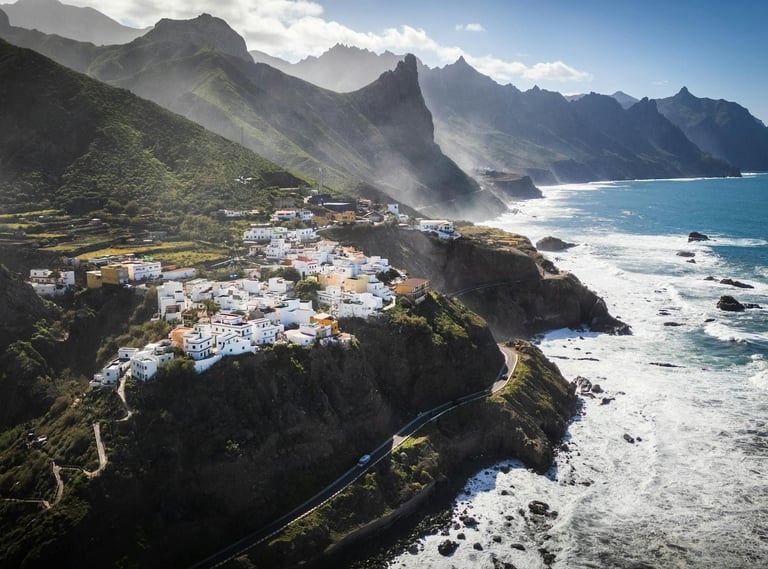
Over the next week, I'd climb that giant, stare down cliffs that made my palms sweat, and scream loud enough on a waterslide to lose my voice. Here's how it all went — the terror, the beauty, and one very bad decision involving a hike I was wholly unprepared for.
The Drive to Masca: Nine Kilometres of Pure Adrenaline
I woke at 6:30am, threw back an espresso, and pointed the car west toward the Teno mountains. Masca is a hamlet tucked so deep into a ravine that pirates supposedly used it as a hideout — a claim no one can prove, but which feels entirely plausible once you see the terrain. The road in is the TF-436, and calling it a road is generous. It's a ribbon of asphalt barely wider than a wheelbarrow, snaking up the mountainside with no barrier between you and a drop that vanishes into mist.
I'm not a nervous driver. I became one. Within five minutes, my knuckles were white and I was muttering profanities at every blind bend. At one point, a tour bus appeared from nowhere, and I had to reverse up a slope with centimetres to spare while a Dutch cyclist watched with the expression of a man who'd seen this a hundred times. The sheer rock wall on one side, the plunging ravine on the other, and the sun not yet high enough to burn off the mist — I drove the last kilometre holding my breath without realising it.
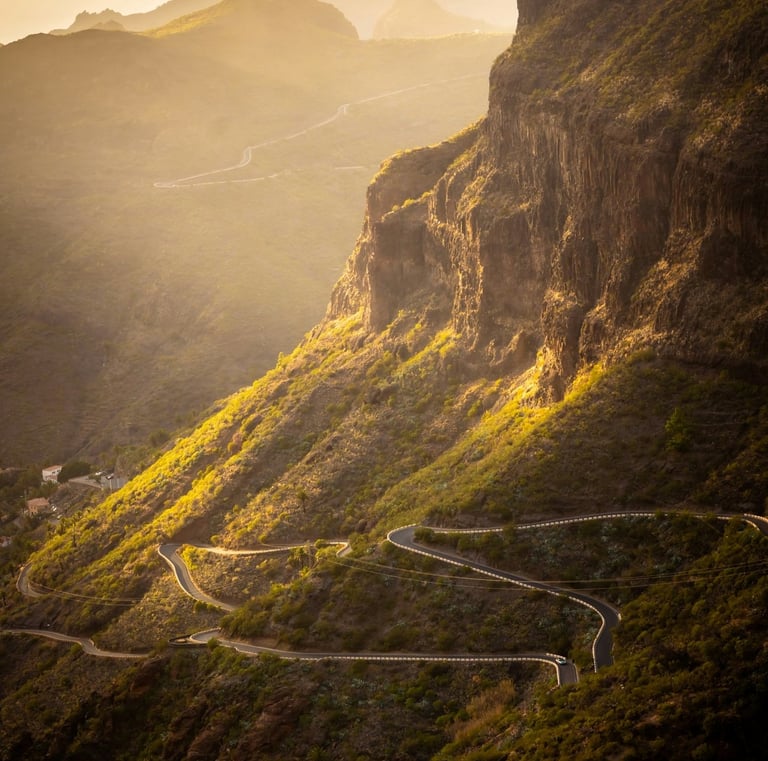
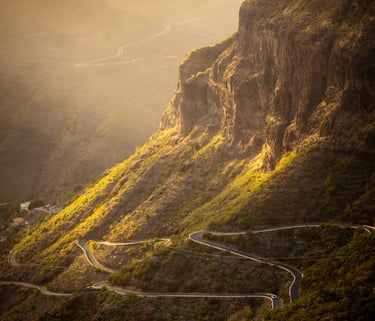
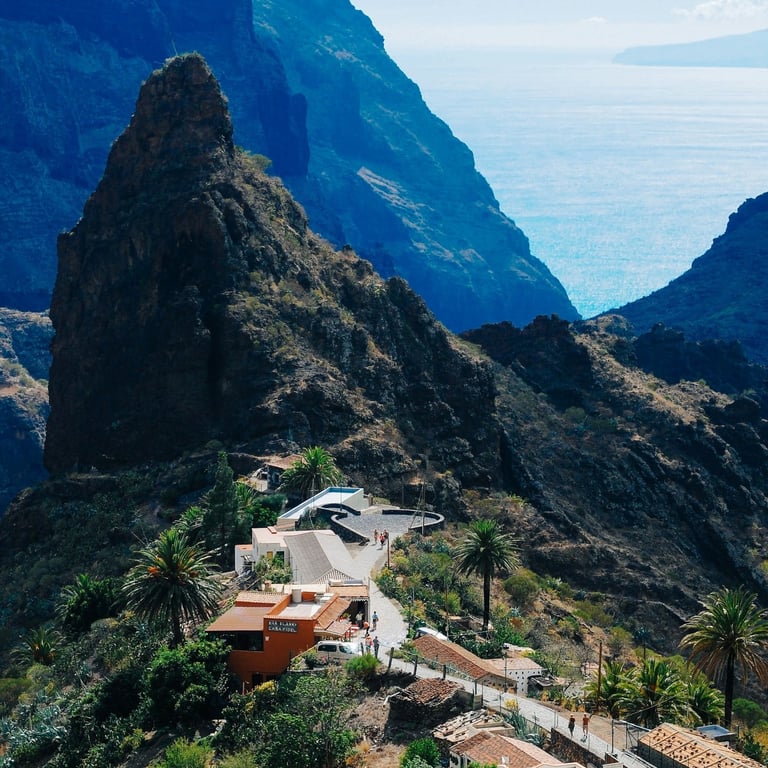
When I finally parked at the top, knees trembling, the view back down the valley silenced me. Jagged peaks, terraced slopes, and the Atlantic glinting far below. I walked into the village and found a café called El Guanche, where the terrace overlooks the gorge. I ordered an almond cake and a coffee and didn't move for half an hour. The owner, a woman whose face was lined like a topographical map, said the road used to be worse. I didn't believe her.
Car park: Carretera Masca, 51, 38489 Masca. Spaces are limited; arrive before 10am or prepare to circle.
Teide National Park: Thin Air and a Silent Summit
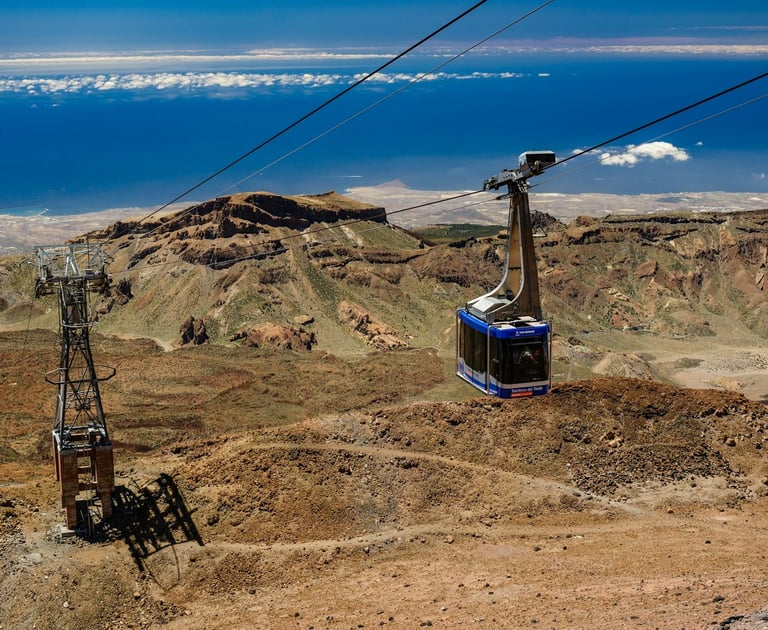
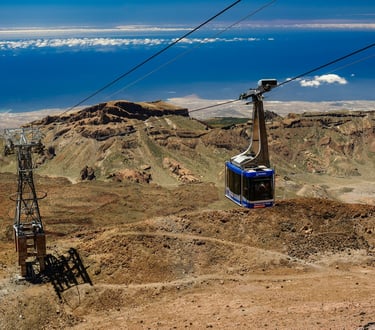
If Masca was all vertigo and adrenaline, Teide was something quieter — a landscape that didn't feel hostile so much as indifferent. The lava fields stretched in frozen waves, rust-red and black, and the road climbed until the pine trees gave up. At the Teleférico station, the air already had that thin, dry quality that makes you conscious of every breath.
The cable car lifted me through zones of rock that looked successively less like Earth: first scree, then bare cinder, then a colour palette stolen from a rusted kiln. At the upper station, 3,555 metres up, I stepped out and the wind hit me hard enough to stagger. A Spanish family beside me gasped audibly. Nobody spoke much after that.
I walked the permitted trails to the lookout points, breathing shallowly, conscious of my heart working harder than it should. At the viewpoint, a man beside me pointed to the horizon and said, simply, "África." I squinted. A faint brown smudge. He nodded once, then turned back the way he came. No further conversation. Just that single word, shared between strangers in thin air.
The view stretched to La Gomera, La Palma, and that distant continent I still wasn't sure I could see. I stood there until my ears ached from the cold, then rode the cable car back down and discovered I'd burned my forehead so badly it peeled for five days. I'd forgotten sunscreen. Teide doesn't offer reminders.
Cable car: book online; €40 return for adults, under €20 for children. Summit permits are free but vanish weeks ahead — apply via the national park website.
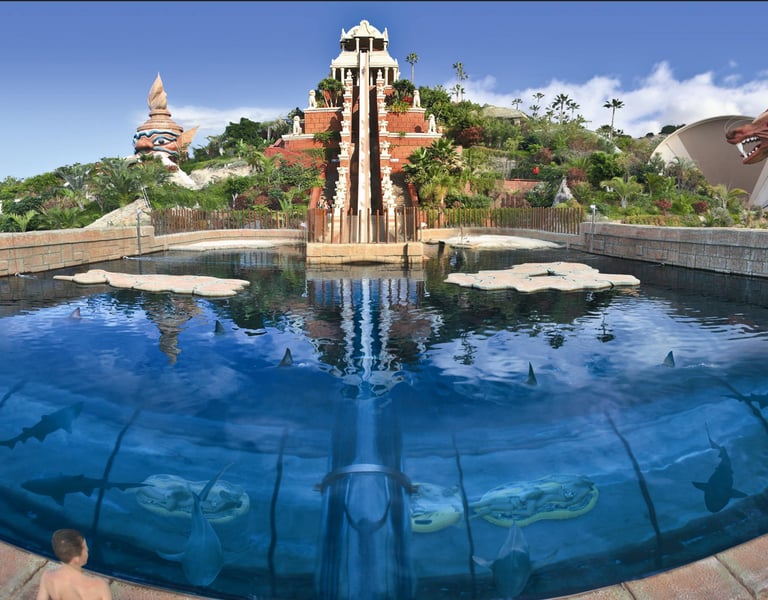
Siam Park: 28 Metres, 80 KPH, One Shark Tank
Let me tell you about the Tower of Power.
The slide drops 28 metres at 80 kilometres per hour through a transparent tube that passes through a tank of hammerhead sharks. The sharks don't care. They glide past as you hurtle through, a human cannonball in board shorts.
My turn. I crossed my arms, leaned back, and the floor vanished beneath me. Four seconds of water, noise, and my own voice doing something I'd hesitate to call screaming — more of a guttural yelp. When I splashed into the pool, I was laughing so hard I swallowed a mouthful of chlorinated water. I got out, staggered round, and joined the queue again. The rest of the park did exactly what it promised: a wave pool churning three-metre swells, a lazy river floating past waterfalls, and the smell of sunscreen and fried dough clinging to everything. I bought an overpriced souvenir towel and napped on it for an hour. No shame.
Address: Av. Siam, s/n, 38660 Costa Adeje. Book tickets online — cheaper and guarantees entry in peak season.
Barranco del Infierno: The Hike That Judged Me
"Barranco del Infierno" means "Hell's Ravine," which was the first warning. The second was the sign at the trailhead listing how much water to carry. I read it. I ignored it.
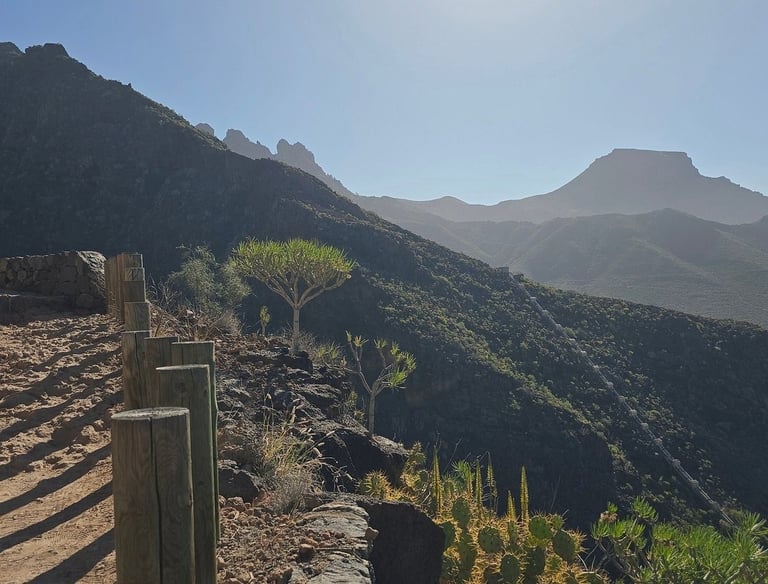
It's a 6.5-kilometre out-and-back through the Adeje mountains, and I started at noon in February because I am an optimist and a fool. The path climbed relentlessly into a gorge where the walls closed in and the air went still and hot. Within twenty minutes, my t-shirt was soaked and I was rationing water like a castaway.
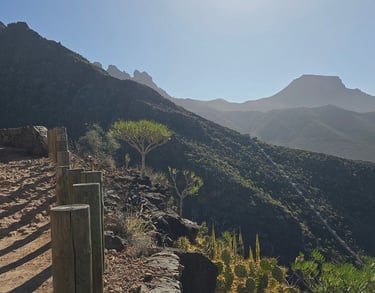
The scenery — sheer rock, wild cacti, a trickle of a waterfall at the end — was beautiful in a stark, sun-bleached way, but I was too dehydrated to appreciate it properly.
A German couple overtook me, hiking poles clicking, gaiters immaculate. They looked at my trainers. They said nothing. They didn't need to. On the return leg, I trudged in silence, muttering the word "water" like a mantra. When I finally reached the car, I drank a litre in one continuous gulp and sat with my head against the steering wheel for five minutes. The ravine is stunning. It also demands respect. I gave it none. Don't be me.
Permits required, booked in advance. Limited daily entries; check availability online.


El Bollullo: The Beach That Fought Back
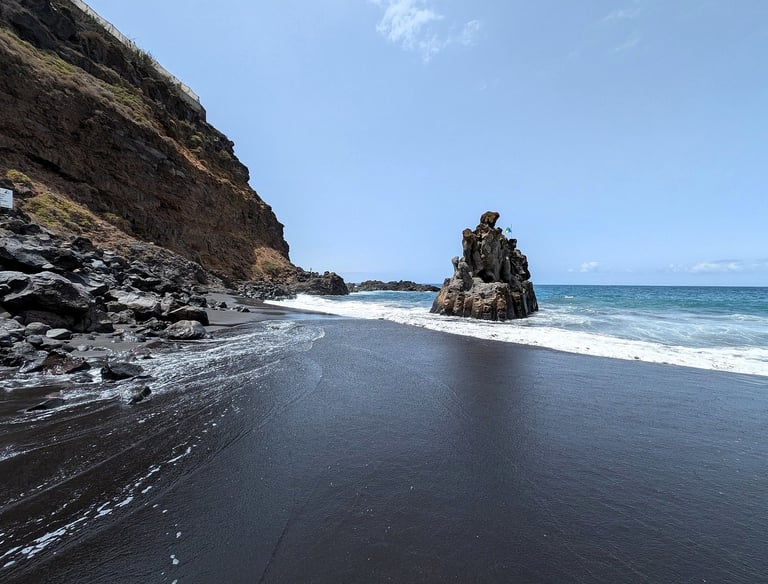
I found El Bollullo by accident, following a handwritten sign through a banana plantation on the north shore. Ten minutes of walking, the fronds rustling overhead, and then the path opened onto a wild stretch of black sand with waves that hit the shore like slaps. No umbrellas. No music. Just the Atlantic doing what it wants.
I swam for five minutes. A wave caught me mid-stride, lifted me, and drove me into the sand with enough force to fill every pocket, seam, and crevice with volcanic grit. I emerged sputtering, a man-shaped sandbag, while a local woman sitting on a towel gave me a look that said: first time? The sand took three days to fully excavate. Worth every grain.
Later, sitting on the shore picking grit from my ears, I watched a dog chase the retreating foam with furious optimism, never catching it, never stopping. Some creatures, I thought, have a better attitude than I do.
Parking: Camino el Bollullo, 114, 38300 La Orotava. Short walk from the car park through banana groves.
Los Gigantes and La Tejita: Cliffs and Silence
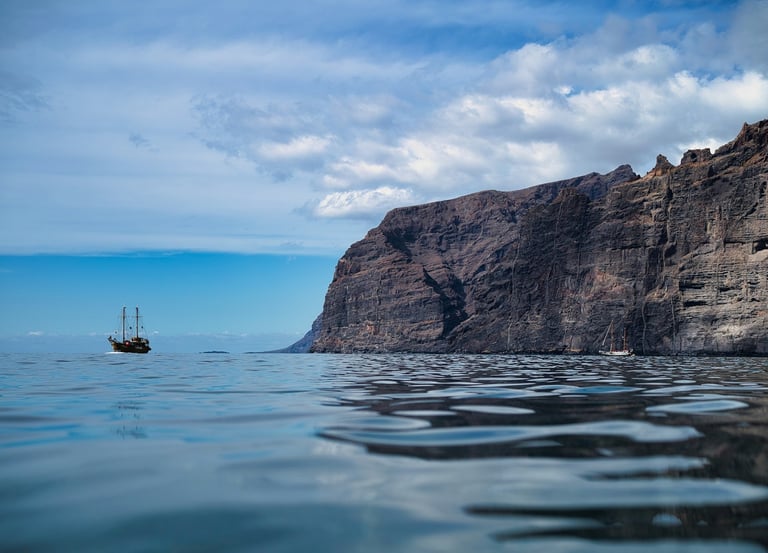
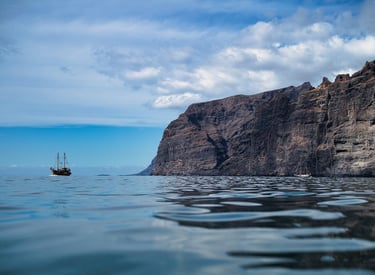
At Playa de los Gigantes, the cliffs do all the talking. They rise from the sea like a wall built by something with no interest in humans.
I rented a kayak and paddled out to their base, where the water turned deep navy and the rock towered so high I had to crane my neck to see the top. Beneath me, the depth fell away into nothing. I drifted, tiny and temporary.
Earlier that week, Playa La Tejita had given me the opposite: a sweeping curve of volcanic black sand beneath the red cone of Montaña Roja, almost empty, the surfers the only punctuation. I sat on the shore and watched them until the sun dropped and the sand cooled beneath my feet. No facilities, no lifeguard, no noise except the hiss of foam retreating over pebbles.
Parking for Los Gigantes: Puerto de Santiago. Parking for La Tejita: 38618 Granadilla de Abona.
The Quiet Corners
I fed a lemur a grape at Monkey Park in Los Cristianos. It took the grape with improbable delicacy, inspected it, and then fixed me with a stare of such ancient judgement I actually apologised out loud. The park is scrappy and small — more a collection of rescued animals than a polished attraction — but that's exactly why I liked it.

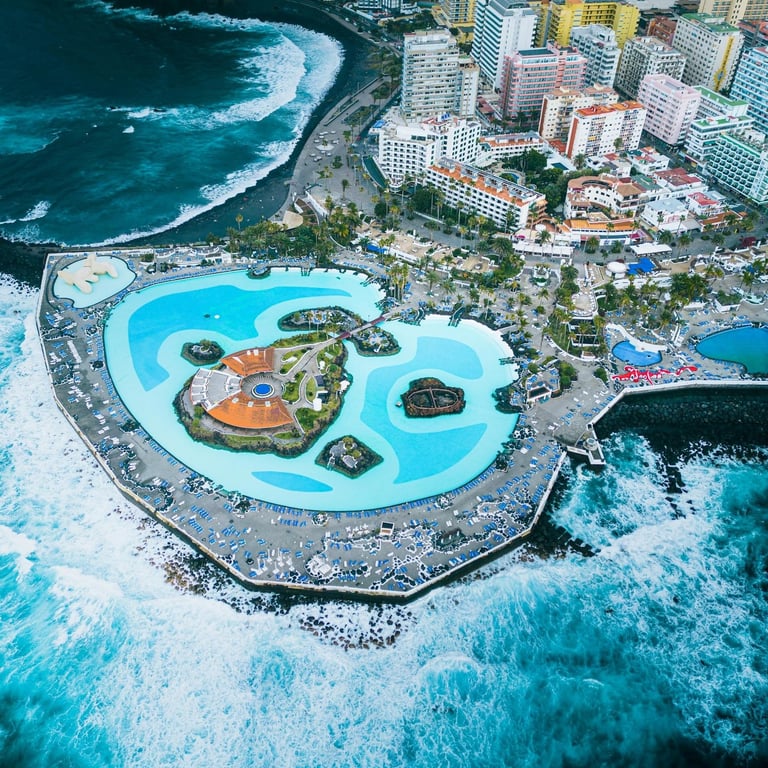
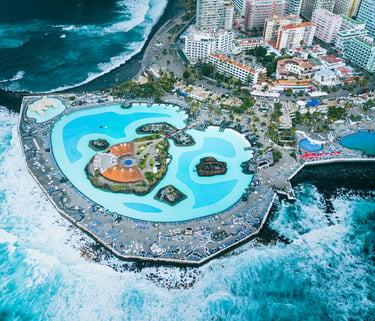
In Puerto de la Cruz, I swam in the saltwater pools of Lago Martiánez, a sprawling complex of volcanic stone designed by César Manrique that felt frozen in a sun-bleached 1970s postcard. The water was cold and bracing, and I shared a lane with a man who did slow, meditative breaststroke for an hour without stopping. The north of the island has a different rhythm. It doesn't perform. It just is.
I left Tenerife with sand still embedded in my hair and my hands still remembering the shape of the steering wheel on that Masca road — the mist, the crumbling edge, the moment the bus appeared and the world narrowed to centimetres.
Some destinations wrap you in comfort. Tenerife burns you when you forget sunscreen. It sends you down mountain passes half a lane wide and waits to see what you're made of. But it also gives you the Atlantic pounding a black-sand beach, a kayak beneath walls of stone, and the thin, cold silence of a volcano that stopped erupting a century ago and still hasn't learned to feel extinct. I'll go back. Probably with better shoes.
Practical Details (What I Wish I'd Known)
Best time to visit: April–June and September–November offer the best mix of warmth and space. February is cooler but mild, and Teide often wears snow.
Flights: Direct to Tenerife South (TFS) from most UK and European cities. Return fares booked 6–10 weeks out: London £50–£220, Paris €70–€260, Madrid €40–€140, Berlin €80–€300, Amsterdam €90–€310. Midweek flights tend to be quieter and cheaper — and you'll actually get an armrest.
Getting around: Rent a car. Cicar and AutoReisen offer fair rates without the sneaky fees other companies bury in the fine print. Full insurance is non-negotiable — the TF-436 to Masca is not where you want to discover your excess is €1,000.


Safety & tips: Sunscreen year-round, even if the sky looks hazy (that's when it gets you). Proper footwear for trails, and double the water you think reasonable for any hike. I learned both the hard way. Tipping is appreciated, not obligatory — round up in cafés and the coffee somehow tastes better.
Where I stayed:
Costa Adeje — H10 Costa Adeje Palace, oceanfront with pools. Doubles from €130/night.
Puerto de la Cruz — Hotel Botánico & The Oriental Spa Garden, lush and peaceful. Doubles from €150/night.
Near Masca — Finca La Hacienda, rural guesthouse with mountain views. Doubles from €75/night including breakfast.
Budget — Casa del Embajador in La Laguna, central and charming, from €60/night. The owner leaves pastries on the landing. I ate four. No regrets.
For Accommodation Ideas, Explore the Map Below
All Rights Reserved
© www.affordabletravel4u.com
Travel Info
Travel Advice