
Crete: Where Myth Walks Out of the Sea
By V.S. Journeys
The oldest stories in Europe begin here.
Not in libraries or archives, but in the soil itself. Dig anywhere on this island — a few centimetres, sometimes less — and you hit something: a sherd of Minoan pottery, a Roman coin, a Byzantine wall. The ground is thick with time. The Greeks say Zeus was born in a cave above the Lassithi Plateau. Whether you believe that or not, something about Crete makes the story feel plausible.
It is the largest of the Greek islands, but size is not the point. The point is what accumulates at this crossroads. The southern coast faces the Libyan Sea. Africa begins three hundred kilometres beyond that horizon. You cannot see it, but you feel its proximity — in the heat, in the quality of the light, in the species of plants that grow nowhere else in Europe. Asia Minor lies east. Europe stretches north. For ten thousand years, people have arrived here — some to trade, some to conquer, some to hide — and every wave left something behind.
You come for the beaches. That is honest. But you leave with something heavier: a sense of depth, of layers, of a place that has seen everything and forgotten nothing.
The First Europeans: Knossos and Phaestos
Before Athens. Before Rome. Before the pyramids were old, the Minoans built palaces on Crete.
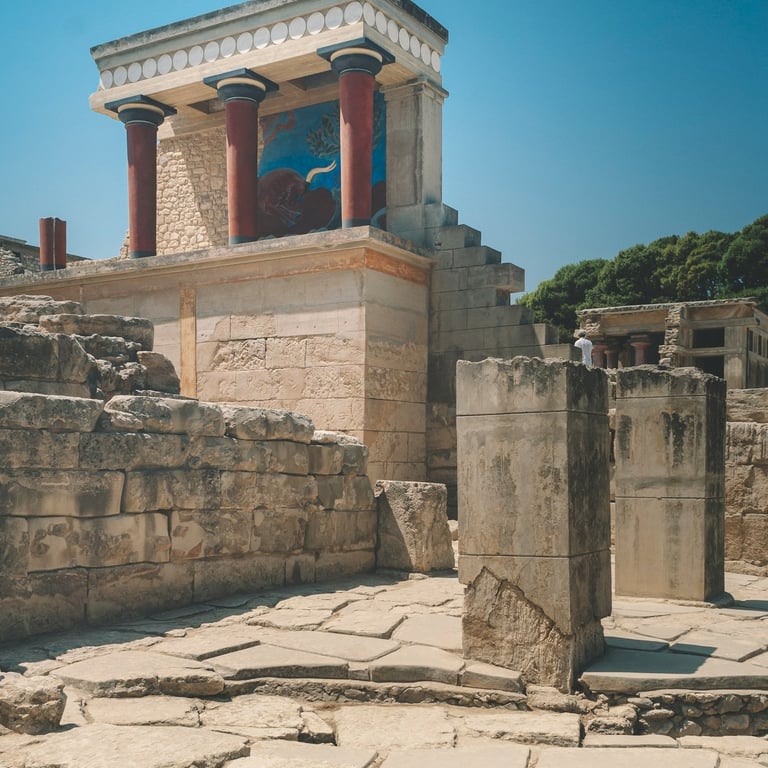
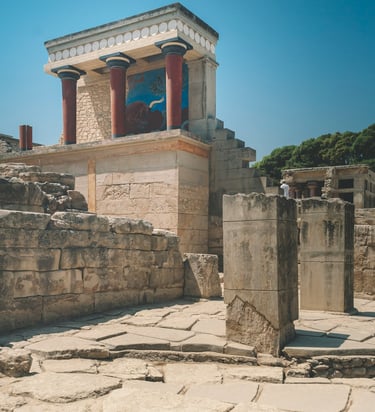
Knossos is the largest. The site spreads across a low hill south of Heraklion, maybe six hectares of courtyards, storerooms, and corridors that twist back on themselves so confusingly that the excavator called it a labyrinth. The myth of the Minotaur — half-man, half-bull, hidden in an inescapable maze — probably came from this layout. Walk it yourself. Turn a corner. Find another room. Turn again. The sense of disorientation is real.
The walls still hold fragments of frescoes: dolphins leaping through blue waves, young men vaulting over bulls, women in elaborate dresses with exposed breasts and elaborate jewellery. These were not austere people. They liked colour. Movement. Celebration. Their palaces had advanced drainage, multi-storey buildings, and light wells that brought sun into the lowest rooms. This was Europe's first civilization, and it was not primitive.
Phaestos, on the other hand, feels different. Smaller. More contained. The famous Phaestos Disc — a clay disk stamped with mysterious symbols that no one has fully deciphered — was found here. But the site itself offers something Knossos does not: silence. Fewer tour groups. More space to stand in the middle of a Minoan courtyard and listen to the wind move through the ruins.
Both palaces were destroyed and rebuilt. Earthquakes. Fires. Invasions. The Minoan world ended eventually — probably after a volcanic eruption on nearby Santorini sent tsunamis crashing into the Cretan coast. But the stones remained. And so did something else: the template for everything that followed.
Parking at Knossos is organised. Arrive before ten.


Samaria Gorge: Walking Through the Mountain
The bus drops you at the top, 1,230 metres up, where the air is thin and the pine scent is overwhelming. The path begins immediately — no gentle introduction. You step onto the trail and the gorge opens below you.
Sixteen kilometres to the sea. Four to seven hours, depending on your legs and your willingness to stop.
The first section moves through forest. Pines. Cypresses. Kermes oaks twisted by wind. The path is wide here, almost generous. Then the walls begin to close. Limestone cliffs rise on both sides — grey, fractured, scored by millennia of water. The Iron Gates is the narrowest point: three metres wide, with walls towering five hundred metres above. You walk through a slot in the mountain. The light changes. The temperature drops. Your voice echoes strangely.
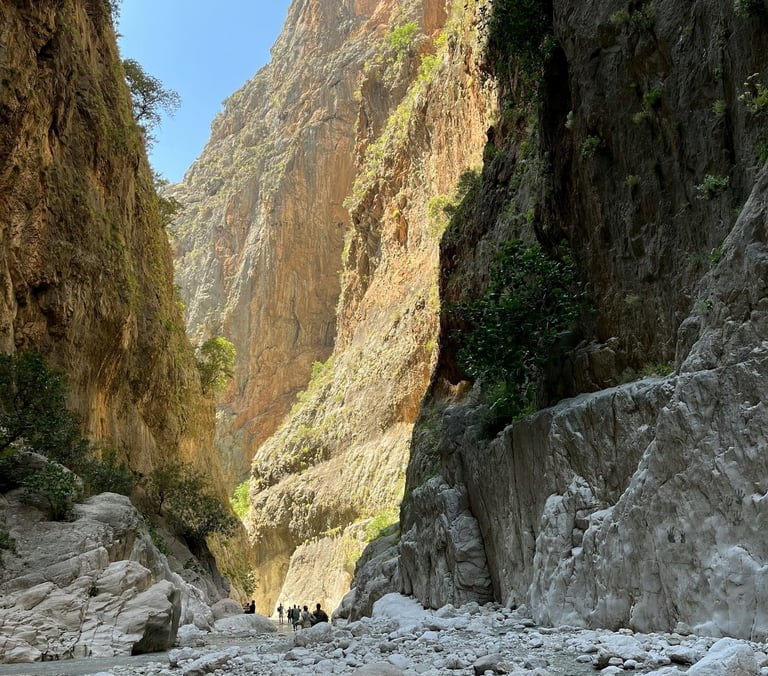
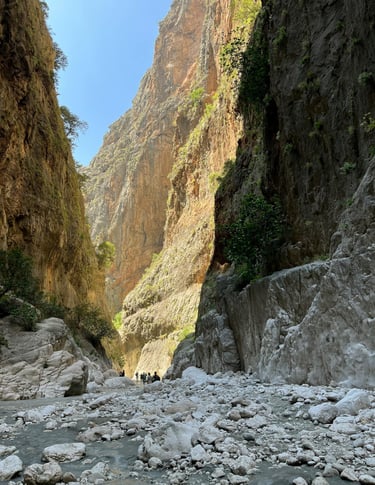
The final section follows a riverbed. The stone is slippery where the water still runs. Loose rocks shift under your boots. There is a particular focus required here — a concentration that pushes everything else out of your mind. That might be the point.
You emerge at Agia Roumeli, a small village on the Libyan Sea. The beach is pebbled. The water is clear and cold. There is a cold beer waiting at the first taverna. You sit. You drink. You look back at the mountain you just walked through. The gorge is invisible from here — just a dark seam in the white limestone. No one who has not walked it would guess what lies inside.
Parking is available at the top. A shuttle system brings you back to your car. The logistics are well-organised. The hike still feels wild.
The Cave Where Zeus Was Born
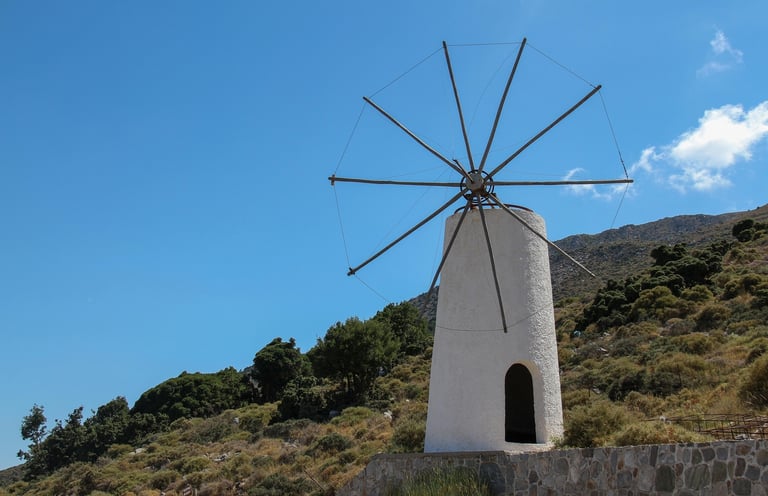
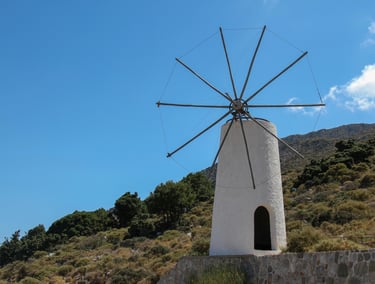
The Lassithi Plateau sits at 850 metres, a flat bowl of fertile land ringed by mountains. Windmills still turn here — not many now, but enough to remind you that this was once the windmill capital of Crete. The air is cooler. The light is sharper. The villages are quieter.
Psychro Cave — also called Dikteon Cave or Zeus Cave — is cut into the mountain above the plateau. The walk up takes twenty minutes. Steep switchbacks. Goats are watching from the rocks. At the top, you pay a small fee and descend into the earth.
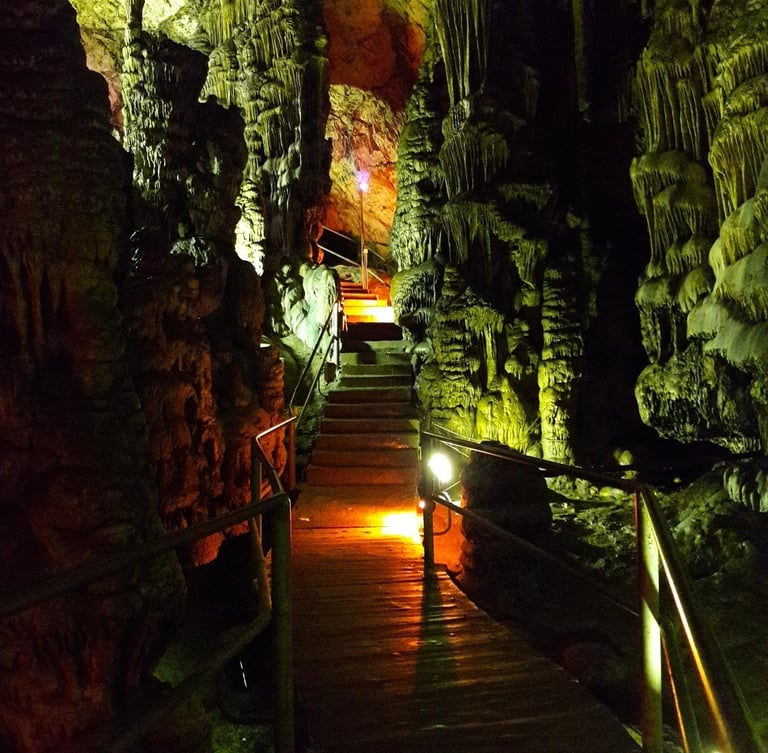
The entrance is a wide hole in the limestone. Steps lead down. The air changes immediately: cooler, damper, heavier. Stalactites hang from the ceiling like frozen chandeliers. Stalagmites rise from the floor. Some of them meet. Some are still separated by centimetres, still growing, still reaching.
The main chamber is vast. A wooden walkway guides you through. Pools of water reflect the coloured lights — artificial, yes, but the cave does not need them. The scale does the work. Stand in the centre. Look up. The ceiling is fifty metres above you. The silence is absolute except for the drip of water somewhere in the dark.
Whether Zeus was born here is a matter of faith. But something about this place feels like an origin. The Minoans thought so too. Archaeologists found thousands of offerings here — bronze figurines, clay models, jewellery — left by pilgrims who came to honour the god of the cave. They stood where you stand. They looked up at the same stalactites. They felt something they could not name.
Parking is available below the cave. The walk is steeper than you expect.
Beaches That Do Not Look Like Europe
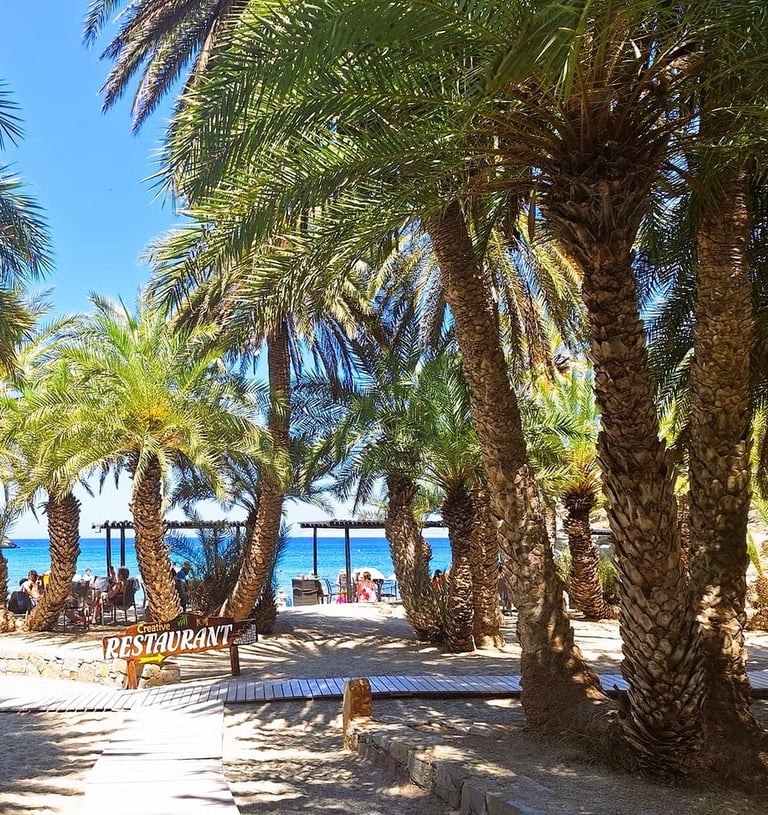
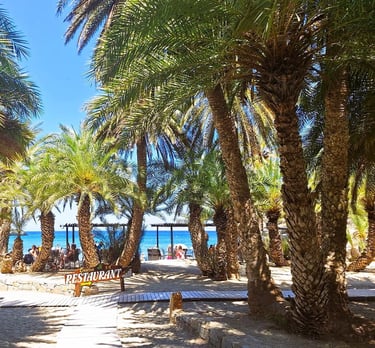
Vai is the strangest beach in Europe. Not because of the water — though that is turquoise — but because of the palm trees. Five thousand of them. A natural forest of Cretan date palms growing right down to the sand. The effect is tropical, almost Caribbean, until you remember you are in the Aegean.
The beach is long. The sand is golden. The water is shallow for metres and metres — safe, warm, good for children and for adults who just want to float. The palm forest behind the beach offers shade. Find a spot under the fronds. Lie back. The sound of the leaves in the wind is not the sound of pine or olive. It is softer. Drier. Foreign.
Vai is on the east coast, a drive from anywhere. That isolation preserved it. The beach was virtually unknown until the 1970s, when a film crew used it as a location and accidentally introduced it to the world. Now there are facilities — a canteen, sunbeds, a parking lot. But the scale remains. Five thousand palms. A curve of gold. Water that shifts from pale blue to deep indigo as the sun moves.
Parking is organised and reasonable. Arrive early in July and August.
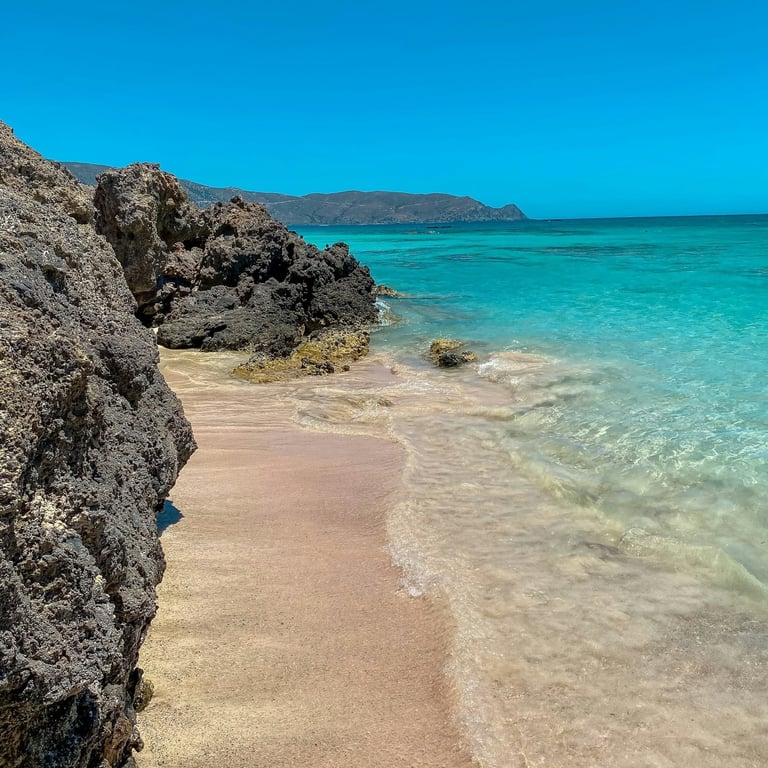
Elafonissi is pink.
Not aggressively pink, not artificial pink, but a soft blush that spreads across the sand like a watermark. The colour comes from millions of crushed shells — tiny fragments of red organisms ground fine by waves and mixed into the white sand. You notice it most in the morning, when the light is low. By midday, the pink is subtler, almost invisible. But it is there.
The beach is technically an island. A shallow channel separates it from the mainland, but when the tide drops, you can walk across. The water never reaches your knees. Children run back and forth, shrieking. Adults wade carefully, holding their sandals.
The lagoon side is shallow and warm. The open sea side has waves and currents. Choose your mood. Either way, the water is so clear that you can see your feet on the sand from chest depth. Schools of tiny fish circle your ankles. The wind is almost constant here, which keeps the heat from becoming oppressive.
Elafonissi sits at the southwestern tip of Crete, a long drive from anywhere. That remoteness is a gift. You do not stumble upon this place. You choose it. You drive the winding roads, past olive groves and goat herds and villages that seem to lean into the hillside for support. And then you arrive. And the pink sand is waiting.
Parking is large but fills by eleven.
Falassarna is for people who want more than a towel and a book.
The beach itself is excellent: kilometres of pale sand, shallow water that warms quickly, views across the sea to the islands of Gramvousa and Agria. You can spend a whole day here doing nothing. Many people do.
But Falassarna rewards movement.
Follow the coastline north. The sand gives way to rock shelves and hidden coves. Some are only accessible at low tide. Others require a scramble down crumbled earth paths. Each one is different — a pocket of turquoise, a patch of shingle, a cave cut into the limestone by winter storms.
Cape Falassarna rises at the northern end. The climb is not long, but it is steep. The reward is a view that stretches from the cape to the Peloponnese on clear days.
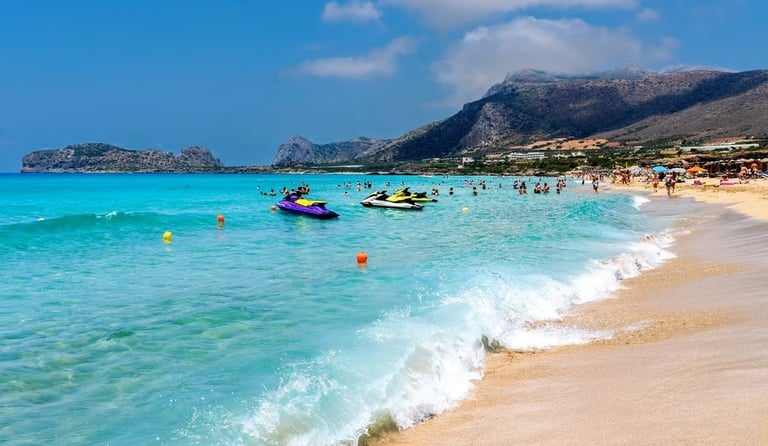
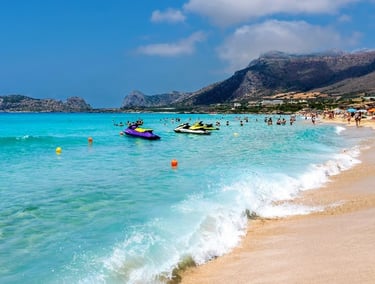
The wind up here is constant. Strong enough to lean into. You stand on the edge of Europe and watch the sea work on the rocks below. The same sea. The same wind. The same sun that the Minoans watched, and the Romans, and the Venetians, and everyone in between.
Parking is free and plentiful.


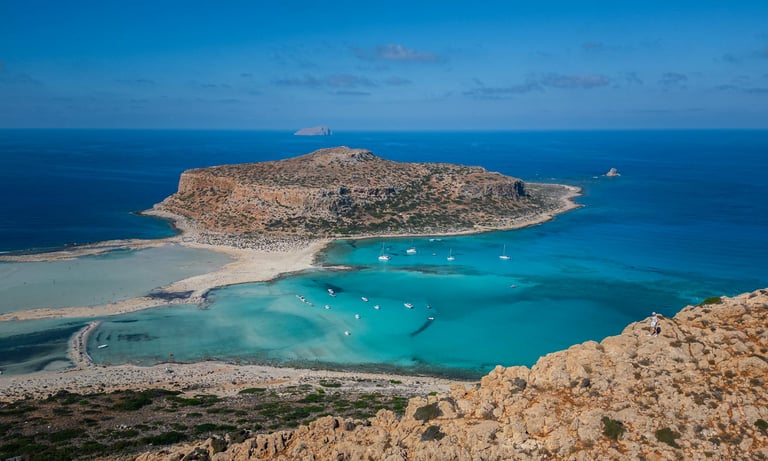
Balos Lagoon requires effort. That is why it survives.
Two ways in. By boat from Kissamos: an hour across the bay, past rugged coastline, with the option to stop at the island of Gramvousa and climb to the Venetian fortress before continuing to the lagoon. The boat drops you on the sand. You have three or four hours. You swim. You eat. You take the boat back.
Or by foot from Kaliviani: a rough dirt road that descends through scrub and rock, steep in places, loose underfoot, entirely exposed to the sun. The walk takes an hour each way. Carry water. Wear proper shoes. The people who hike in flip-flops regret it.
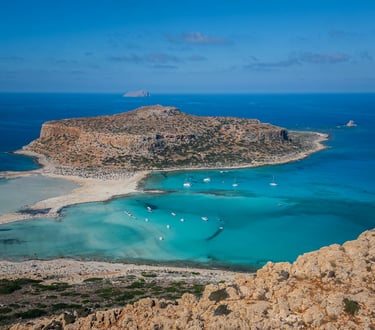
The lagoon itself is shallow — waist-deep for a hundred metres. The water is warmer than the open sea. The sand is white and soft. The cliffs that curve around the bay block the wind. The effect is sheltered, almost intimate, despite the crowds that arrive by boat.
The colour of the water changes as you wade out. Pale green near the shore. Bright turquoise a few steps further. Deep blue where the channel cuts through to the open sea. You can see the line where the lagoon meets the ocean — a clear demarcation, one body of water giving way to another.
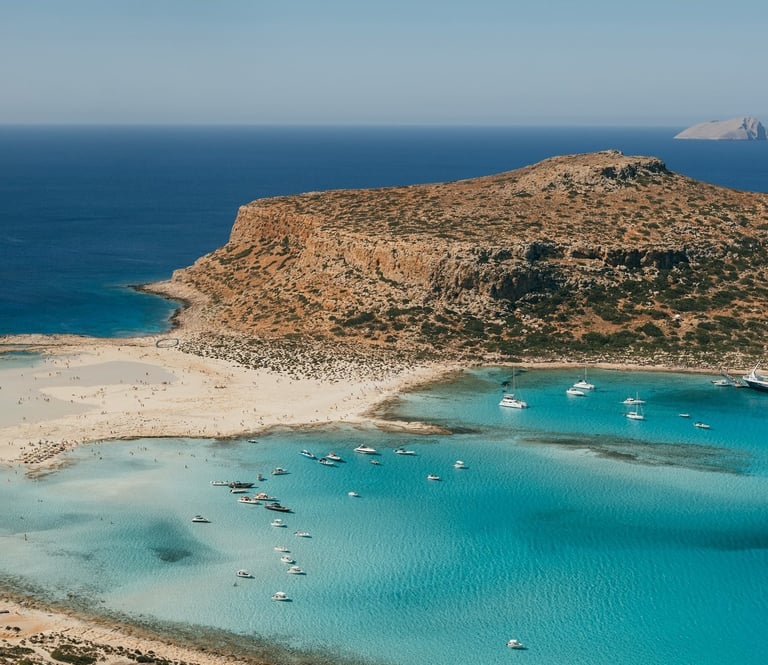
Balos is not a secret. Everyone knows about it. But the effort required — the boat or the hike — filters the crowds enough that the magic remains. The sunset here is extraordinary. Stay late if you can. The boats leave by late afternoon. The hikers depart with them. For an hour, the lagoon empties. That hour is the best.
Parking at the trailhead is informal and fills early.
The Quiet Beaches of the North
Not every beach needs a legend.
Voulisma Beach, near the village of Istron, is a local favourite. The bay is shallow. The sand is soft. The water stays warm until late autumn. Families come here. Groups of friends. Couples who have been together long enough to sit in silence.
There are hidden coves around the headlands. Explore them. The limestone here is pitted with sea caves, some accessible by swimming, some by scrambling over rocks. Each cove is a little different. A different shape. A different colour of water. A different quality of light.
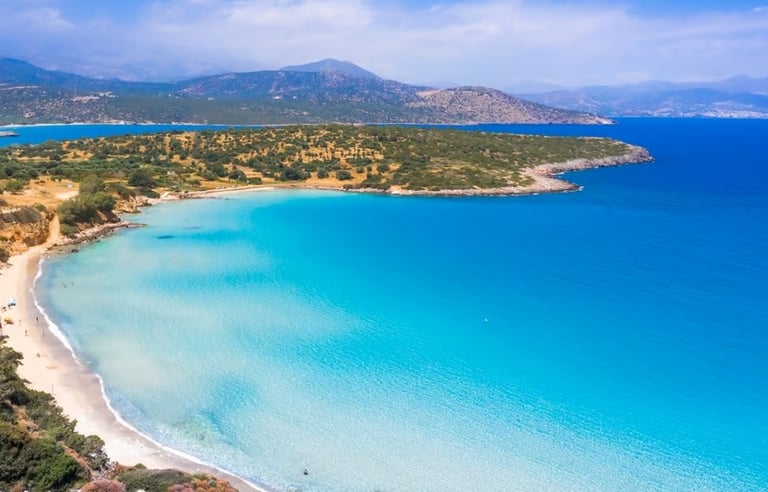
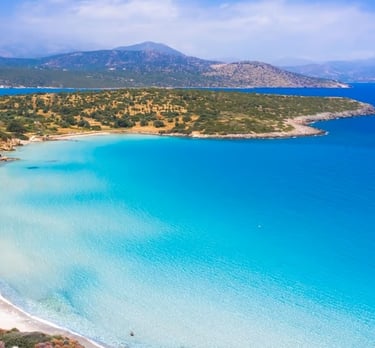
No grand narrative attaches to Voulisma. No myth. No fortress. Just a beach that works, that pleases, that does its job without needing to announce itself. That is a kind of perfection too.
Parking is nearby and easy.
Spinalonga: The Island of Two Histories
The boat leaves from Elounda, Plaka, or Agios Nikolaos. Fifteen minutes from Plaka. Half an hour from Elounda. The crossing is smooth, sheltered by the Mirabello Bay. The island grows slowly on the horizon — low, humped, fortified.
Spinalonga was first a Venetian fortress. The walls are still intact, running the full perimeter of the island. Cannons point out to sea, aimed at an enemy that never came. The Venetians held this island for centuries, using it to guard the entrance to Elounda's natural harbour. When the Ottomans finally conquered the rest of Crete, Spinalonga remained Venetian for decades longer — the last holdout, the final flag.
Then it became something darker.
In 1903, Spinalonga was turned into a leper colony. People with Hansen's disease were sent here — exiled, essentially — to live out their lives in quarantine.
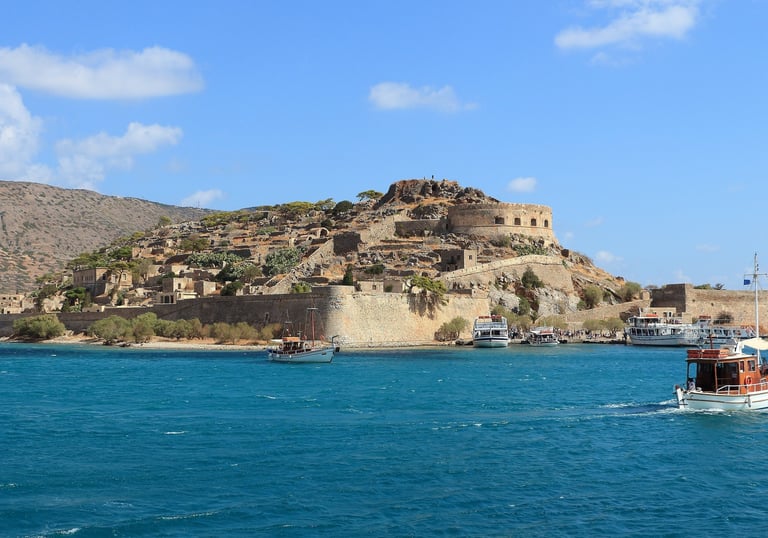
The last resident left in 1957. The buildings remain: houses, a hospital, a theatre, a small church. You can walk through them. You can see the cisterns where they collected rainwater. You can stand in the room where the priest held services for people the mainland had forgotten.
The Victoria Hislop novel The Island made Spinalonga famous. But the island needs no fiction. The facts are enough. A community of outcasts built a functioning society here. They elected their own leaders. They had weddings and funerals and fights and reconciliations. They lived as well as they could in a place designed to hide them.
Walking through the leper colony is quiet. Other tourists move through. Voices are low. The sun is bright. The water is impossibly blue. The contrast is jarring and necessary. Beauty and suffering occupied the same small island. They always do.
Parking is available at the departure ports. The boat schedule varies by season.
Kourtaliotiko Gorge and Preveli Beach: River's End
Most visitors to Crete never find the Kourtaliotiko Gorge. It sits inland from the south coast, west of the main road, unmarked except for a small sign. The entrance is sudden: a narrow gap in the limestone where the road disappears and the river takes over.
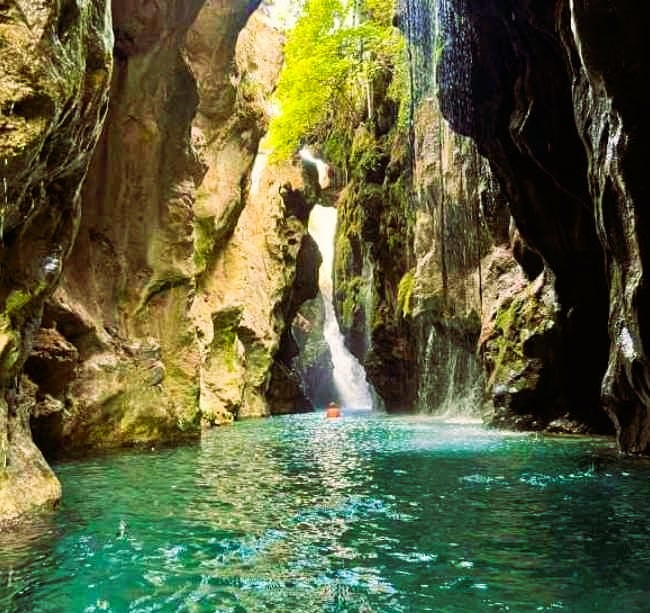
The hike follows the riverbed. Cliffs rise on both sides — two hundred metres, three hundred, in places five hundred. Moss drips from the rock. Ferns grow from cracks. The sound of water echoes off the stone, amplified, disorienting. You cannot tell which direction the sound comes from.
The pools are the reward. The river cuts deep holes into the limestone — circular, smooth-walled, impossibly clear. The water is cold. Colder than you expect, even on a hot August afternoon. The plunge is a shock that turns into pleasure after fifteen seconds. You float on your back. You look up at the strip of sky between the cliffs. You feel very small and very present.
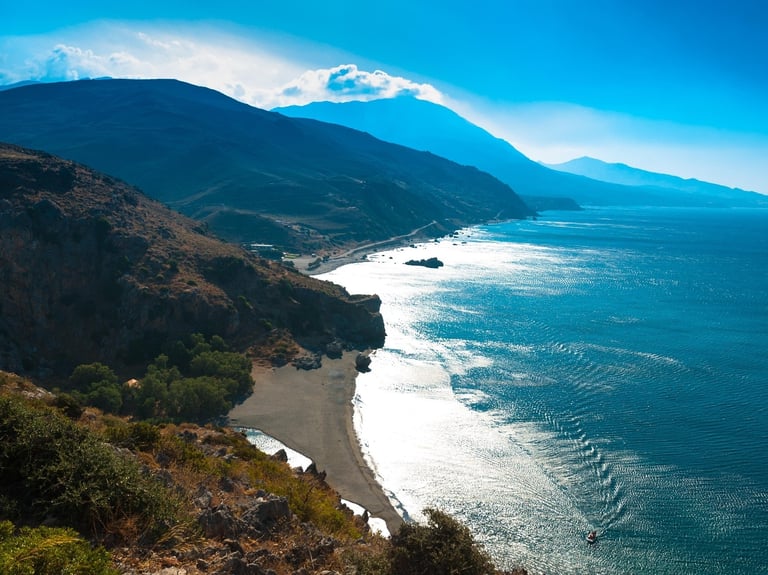
The gorge opens onto Preveli Beach. The transition is immediate: from dark canyon to wide sky, from cold pools to warm sea.
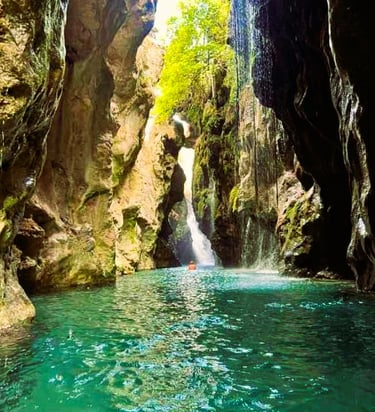
A grove of palm trees grows here — smaller than Vai, less famous, but more dramatic because of the cliffs that frame it. The river meets the sea. Fresh water and salt. The place where one ends and the other begins.
The beach is pebbled. The water is clear. The palm trees cast shifting shadows. You can swim in the river or the sea or both. You can climb the cliffs for photographs. You can lie in the shallows and watch clouds move across the blue.
The walk from the gorge to the beach is short. The walk back is longer — uphill, exposed, a reminder that you earned this place.
Parking at the gorge entrance is free and limited. The road down to the beach is rough. Most people park at the top and hike.

Walking Away
Crete gives you options. That is its genius.
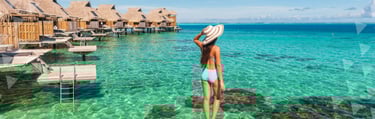
You can spend a week on the north coast, moving from beach to beach, eating grilled octopus in the evenings, and call it a success. You can hike the Samaria Gorge, visit Knossos, swim at Elafonissi, and feel like you have seen everything. You can stay in one village, learn the names of the local cats, and leave without checking off a single sight.
The island does not care which you choose. It has been here for ten thousand years. It will be here when you leave. The stones will remain. The sea will keep turning from turquoise to indigo and back again. The palm trees will sway. The caves will drip.
And somewhere, in the shallows of a lagoon or the cool dark of a gorge or the silence of a Minoan courtyard, you will feel it: the weight of a place that has seen everything and is not impressed by anything. Not by you. Not by the empires that came before you. Not by the ones that will come after.
That is not coldness. That is perspective.
Crete gives you that too.
For Accommodation Ideas, Explore the Map Below
All Rights Reserved
© www.affordabletravel4u.com
Travel Info
Travel Advice