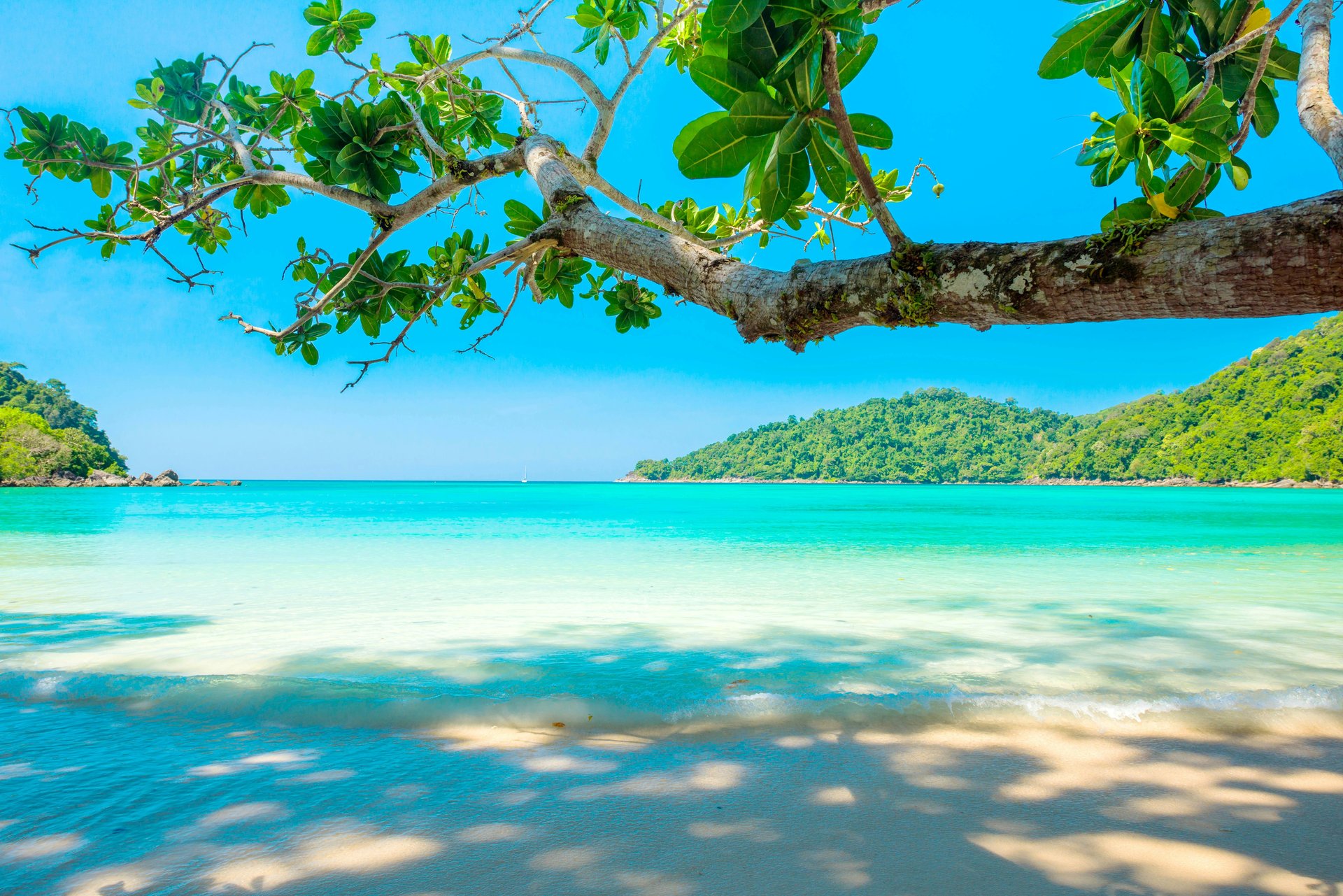

Barcelona Chaos and Costa Brava Silence
By V.S. Journeys
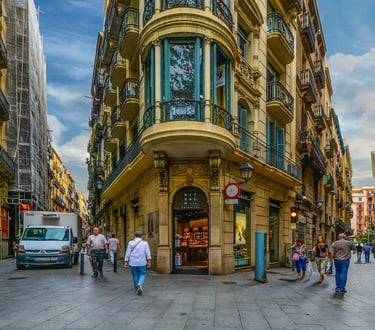
I touched down in Barcelona in mid-May with a phone that had died somewhere over the Pyrenees and the address of a guesthouse that turned out not to be near Las Ramblas at all. I wandered the Gothic Quarter for forty minutes, increasingly lost, until an elderly woman folding laundry on her balcony took pity on me and pointed vaguely downhill. "Allí," she said, which I took to mean "that way." It did.
The guesthouse was above a bakery. The smell of fresh bread seeped through the floorboards each morning at 5am. For five nights, I used it as a base.
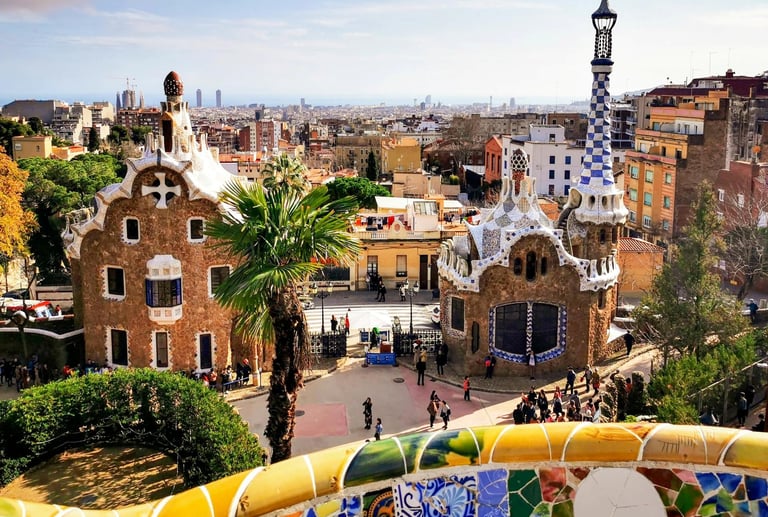
Gaudí's architectural strangeness. A tapas bar where you eat standing up. A beach where an old man taught his grandson to fish in the shallows. Then I rented a car and drove north to the Costa Brava, where the Mediterranean crashed against cliffs and everything slowed down. I also spent a day climbing Montserrat, where clouds drifted through the valley below and I ate a sandwich at the summit in silence.
What follows is the trip as it actually happened: the missteps, the restaurant where I accidentally ordered tripe, and the morning I hiked down to a hidden cove and discovered paradise requires a very steep return journey.
First Contact: The Boqueria Before the Storm
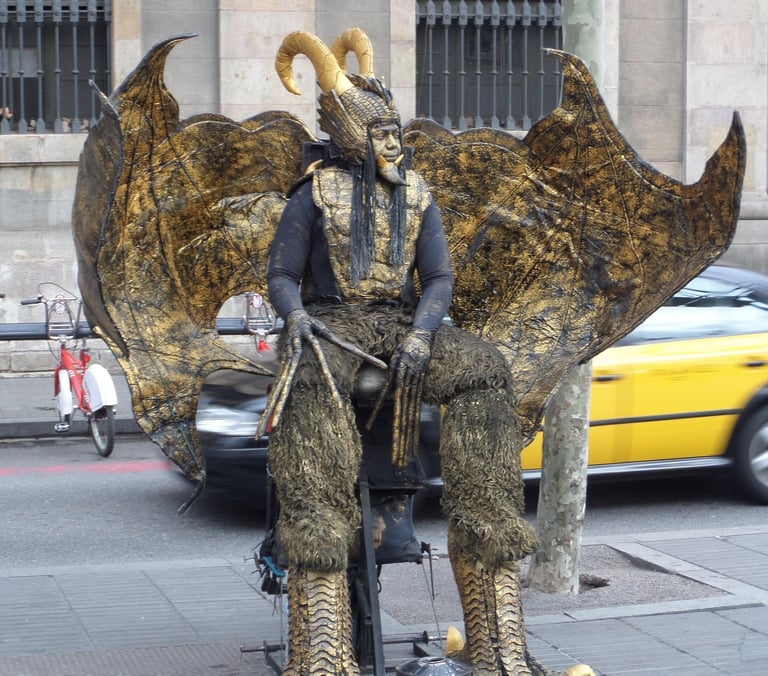
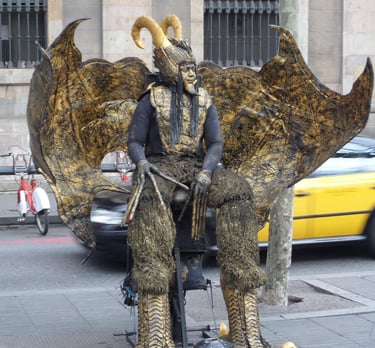
My first morning, I headed straight for Las Ramblas, which by 10am was already heaving. Street performers painted silver stood motionless on boxes. A man thrust a flamenco flyer into my hand. By the time I reached the port I had been offered three selfie sticks, two massages, and something that appeared to be a cannabis lollipop. I didn't linger. Las Ramblas felt less like a street and more like a conveyor belt, and I'd had enough.
But tucked just off it is the Boqueria Market, and I arrived early enough the next day to see it properly. At 8am the stalls were still setting up, the counters gleaming with fresh fish and pyramids of fruit. I bought a cone of jamón ibérico from a man who sliced it so thin you could read through it. For €4, I leaned against a counter and ate cured meat while the city stirred. By 11am the market was impassable. Go early or don't go at all.


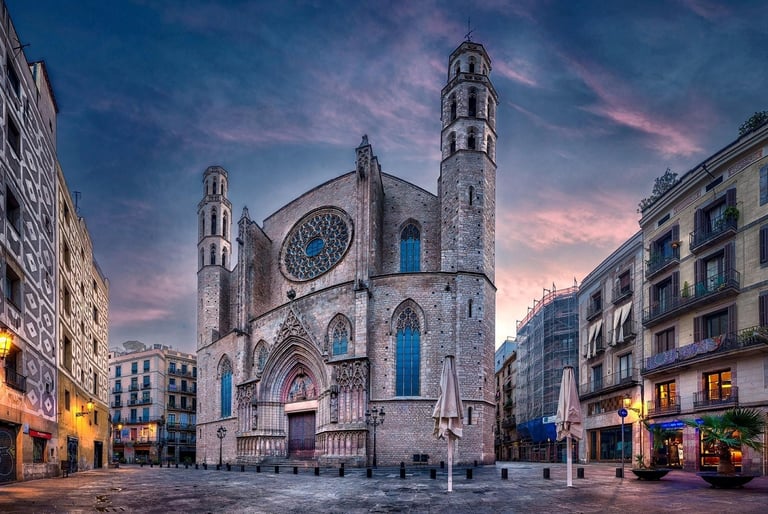
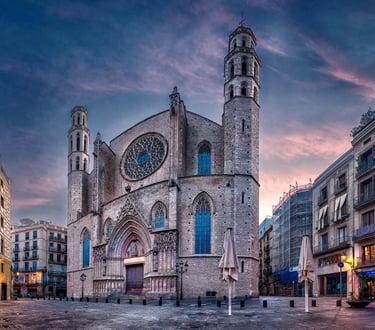
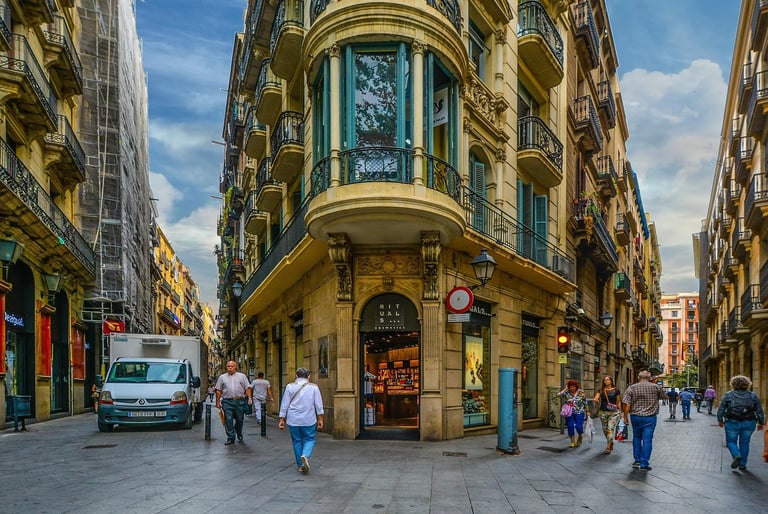
The Gothic Quarter unfurled behind the cathedral like a medieval knot. I got deliberately lost. Narrow alleys opened abruptly into sun-drenched squares. I stumbled upon Santa Maria del Mar, a church so perfectly proportioned that I sat in a pew for twenty minutes just to absorb the quiet. A choir was rehearsing in a side chapel. Outside, I found a tiny café where I promptly knocked over my cortado with an overenthusiastic elbow. The waiter replaced it without a word. "Pasa," he said. It happens. That small kindness has stayed with me.
Gaudí: A Church Made of Light
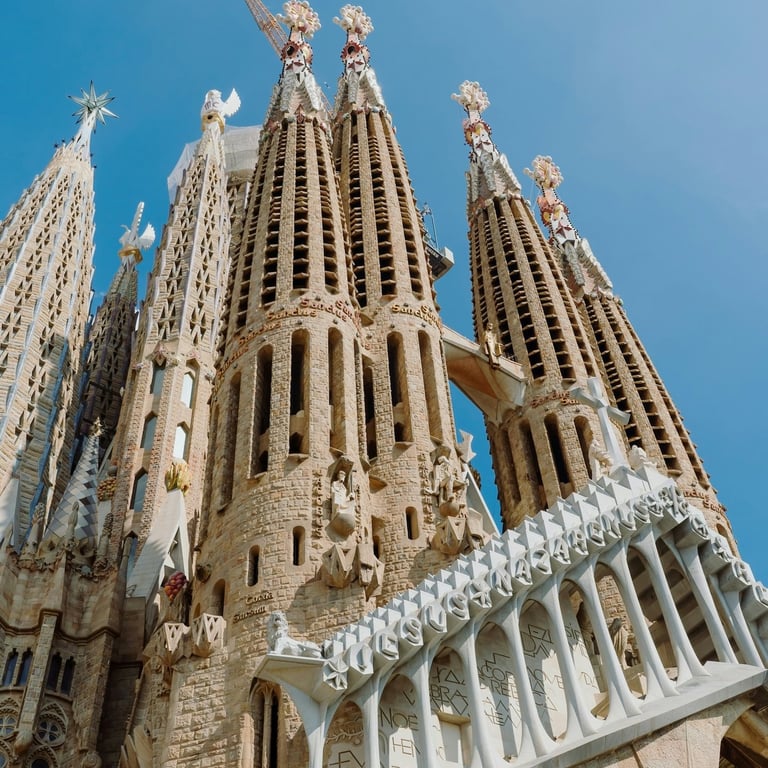
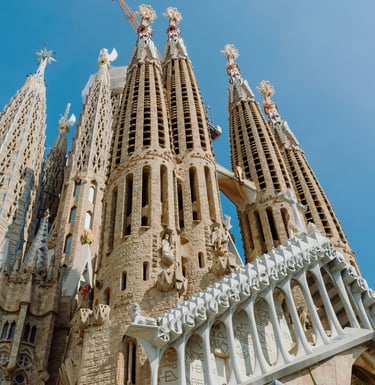
The Sagrada Familia is strange up close. The Nativity façade drips with stone vegetation, turtles holding up columns, figures emerging from the rock as though they're being born from it. I'd booked a ticket online two weeks before — the queue for walk-ins stretched around the block, and people were being turned away at the gate.
Inside, the columns branch like trees. The light through the stained glass paints sections of the floor in pools of blue, green, amber. I found a seat against a pillar and stayed for an hour while an audio guide told me Gaudí had died in 1926 after being hit by a tram, his pockets empty, mistaken for a beggar. They're still building his church. The planned completion is 2026, though every Barcelonan I asked gave a different date and a knowing shrug.
Park Güell required a timed-entry ticket and a steep climb that left me sweating. May sunshine was warm but not yet brutal, and jacarandas were beginning to bloom in patches of purple across the city.
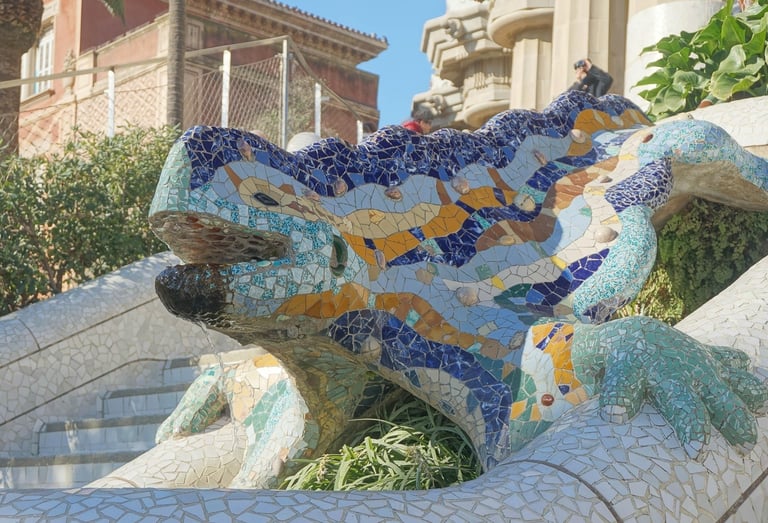
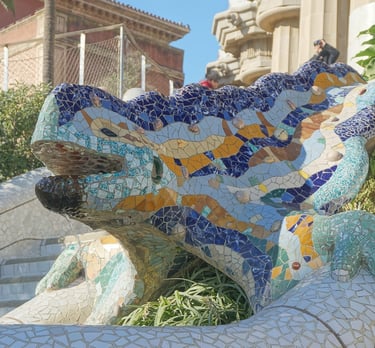
The famous mosaic lizard was besieged by selfie sticks. I hung back and waited. After about ten minutes, a gap opened. I took one photo, then moved on. The serpentine bench was only half-full, and the view over the city was spectacular.
On Passeig de Gràcia, I walked past both Casa Batlló and Casa Milà — La Pedrera. The Batlló façade shimmers with tiles and dragon-scale curves. La Pedrera undulates in stone, its rooftop chimneys twisting into shapes that look like they might start moving. I only entered La Pedrera, and at dusk the stone glowed pink while the chimney stacks cast long shadows. A couple was taking wedding photos against the skyline. Even the bride looked small against those chimneys.
Montserrat: Clouds, Silence, and a Funicular
On my fourth day, I took a train from Plaça d'Espanya to Montserrat, the serrated mountain that rises an hour outside Barcelona. The train was packed with day-trippers and a school group singing a football chant I didn't recognise. I stood in the vestibule, pressed against a window, watching the city dissolve into ochre hills.
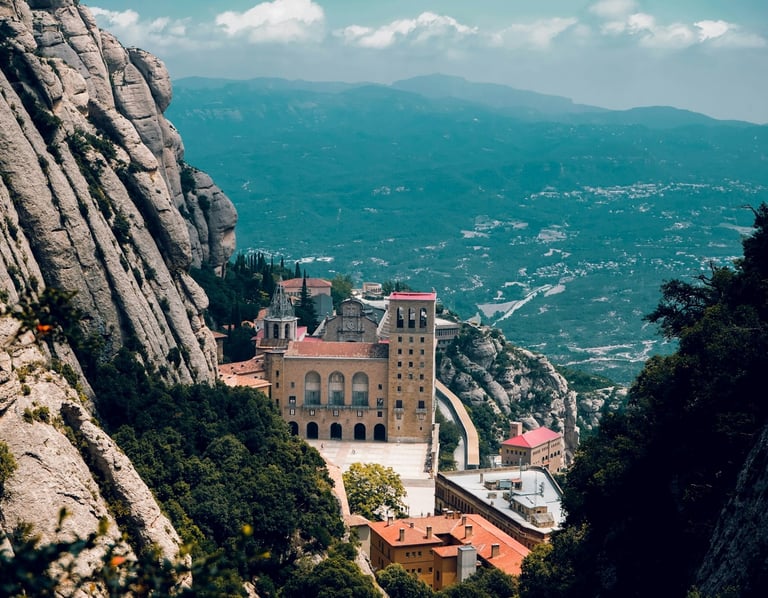
The monastery clings to the rock face halfway up. I took the funicular to the summit and hiked the trail to Sant Jeroni, the highest point. I'd underestimated the climb. The path was rougher than expected — loose stones, narrow ledges, a drop to one side that made my calves ache and my stomach tighten.
At the top, the view opened out over the whole of Catalonia — mountains folding into plains, clouds drifting through the valley below. I sat on a rock and ate a sandwich I'd bought at the station café. It was slightly stale. It was also one of the best meals of the trip. The Black Madonna sat inside the basilica, dark wood gleaming behind glass, a queue of pilgrims shuffling past. I didn't join them. I walked the gardens instead, where the air smelled of rosemary and the only sound was wind.
Montjuïc, the Beach, and a Meal I'd Rather Forget
On a hazy Tuesday, I took the cable car up to Montjuïc. The castle at the summit overlooked the port, where cruise ships disgorged thousands of passengers into the old city. Up here, the breeze was clean and the crowds were thin. I walked through the cactus gardens and found a bench overlooking the sea. A man nearby was painting the view in watercolours. I didn't speak to him.
Barceloneta Beach was busy but pleasant. I swam while families built sandcastles and a small dog chased a seagull and lost. A group of men played volleyball nearby. The water was clear and cold enough to make me gasp.
That evening, I made a tactical error. I'd heard that Carrer de Blai was the street for pintxos — small Basque-style tapas speared with toothpicks. What I didn't account for was my own inability to identify tripe. The first bite was fine. The second bite was chewy. The third bite I quietly wrapped in a napkin and hid under a bread roll. The bartender saw me do it and smirked.
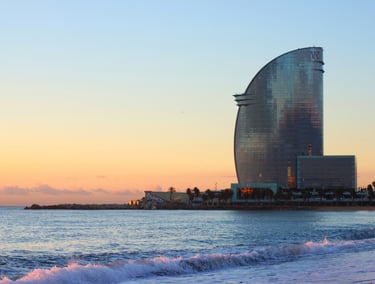
Costa Brava: Something Slower
On day six, I picked up a rental car — a compact Seat — and drove north. The city thinned. Factories gave way to pine forests, then to glimpses of sea between hills.
The Costa Brava means "Wild Coast." Cliffs plunge directly into the Mediterranean. The road hugs the shoreline before pulling inland through cork oak groves, then spits you out at another bay. I'd rented a small apartment near Calella de Palafrugell, a fishing village of whitewashed houses and painted boats pulled up on the sand. The balcony overlooked a cove where children were jumping off rocks into water so clear I could see the bottom six metres down. In May, the village still felt half-asleep — restaurants had just reopened for the season, and the beaches hadn't yet acquired their summer density of sunloungers.
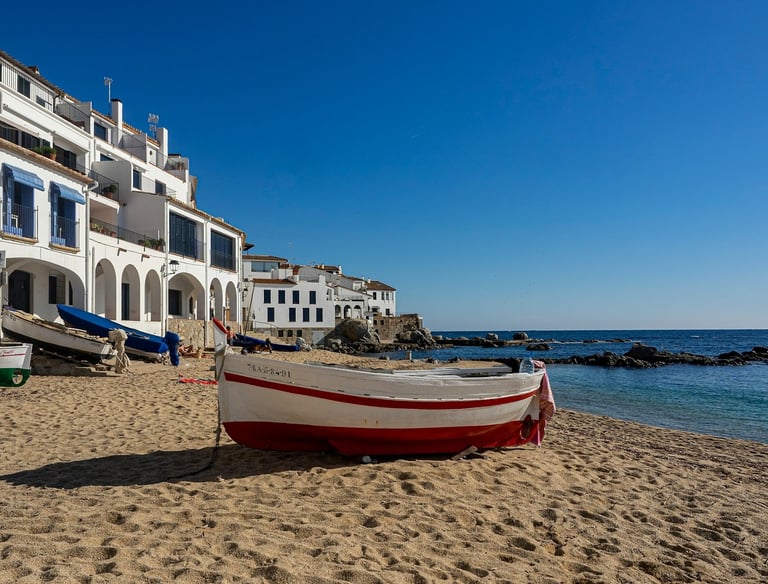
That evening, I ate at a restaurant where the menu was handwritten and the waiter pointed at the fish on display rather than describing them. I chose a sea bream. It arrived grilled whole, dressed with olive oil and lemon. I ate it slowly while the sun dropped behind the headland. A cat wove between the table legs.
Tossa de Mar, a Garden, and a Hike I Regretted Midway
Tossa de Mar lies a short drive north. Its medieval old town, Vila Vella, sits on a headland with walls dating to the 12th century. I walked the ramparts in the late afternoon, the sea churning against the cliffs below. Turrets stood silhouetted against a sky turning orange. Nobody else was there.
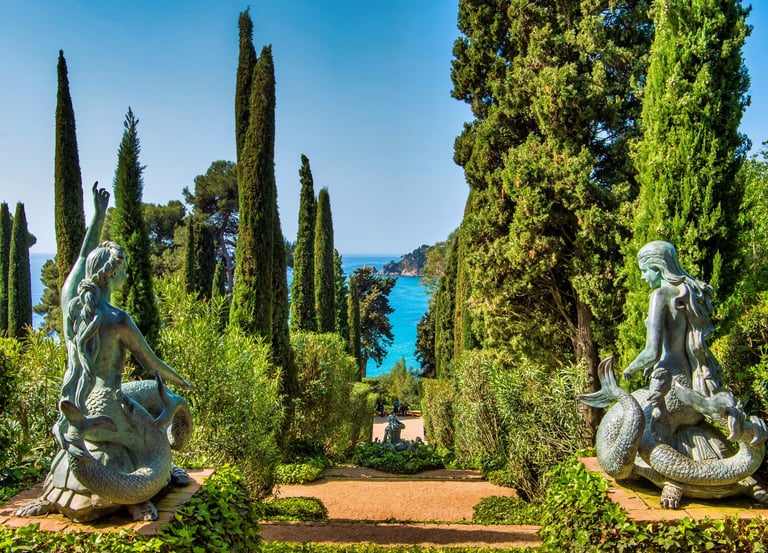
Earlier that morning I'd driven to Lloret de Mar, which was a mistake. High-rise hotels, English breakfast signs. I didn't stay. Instead, I found the Jardins de Santa Clotilde on a clifftop just outside town. The gardens are Italianate, with cypress-lined paths and marble benches positioned exactly where the view of the Mediterranean opens up. Wisteria hung heavy with purple blooms, and the air smelled of jasmine.
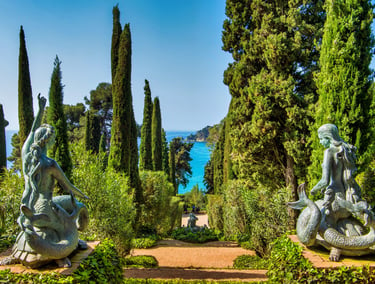
That evening, back near Calella, I attempted to hike down to a cove I'd spotted from the road. The path was steep and unpaved, the steps worn into the rock face uneven. I made it down to find a beach of white pebbles and water so turquoise it looked artificial. I swam. The water was cooler than I'd expected — it was only May — but the shock of it felt good. The climb back up was brutal: calves burning, breathing ragged. But the cove stayed with me.
Girona: Stone Steps and Silence
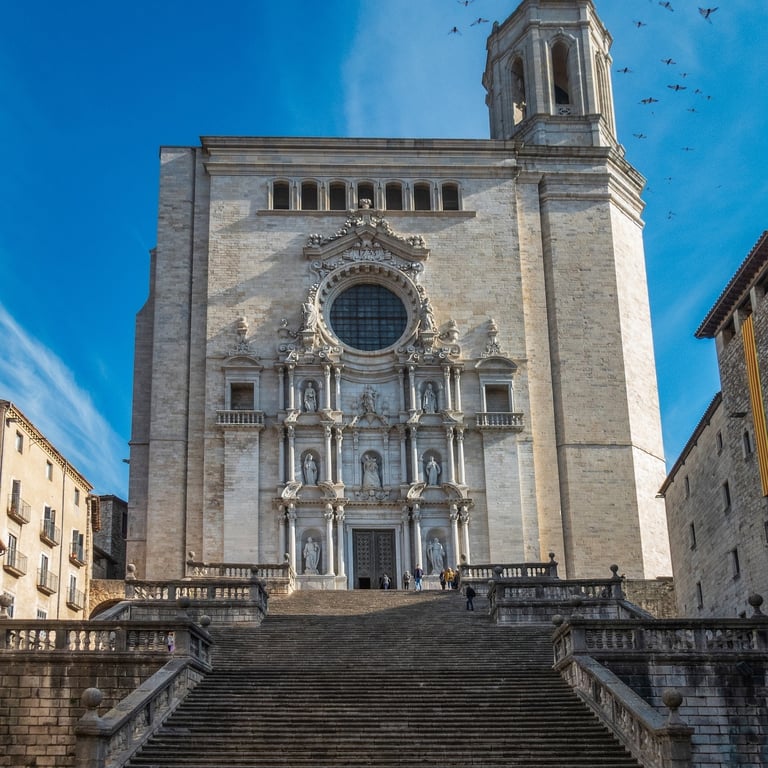
On my final coastal day, I drove inland to Girona. The city straddles the Onyar River, and the first view from the stone bridge — pastel houses reflected in the water — stopped me mid-step. The old Jewish quarter, El Call, is a warren of stone alleys and sudden staircases. I climbed the cathedral steps, the same ones that stood in for King's Landing in Game of Thrones. A couple was posing at the top, arms outstretched. I waited for them to finish, then walked inside.
The nave is vast. I later learned it's the widest Gothic nave in the world, but at the time I just stood there, neck craned, swallowed by the scale of it. The silence inside was almost physical. I sat in a wooden pew and listened to my own breathing. A priest lit candles near the altar. The air smelled of wax and old stone.
I ate lunch in a square near the river: grilled vegetables, a glass of vermouth, bread with tomato rubbed into it the Catalan way.
The waiter corrected my Spanish pronunciation with the patience of a man who had heard worse and would hear worse again.
I flew home with a small bag of sea salt crystals from a rock pool near Calella and a sunburn that traced a perfect arc across my shoulders. Barcelona had been a city of elbows, noise, and sudden pockets of quiet — a church made of light, a choir behind stone walls, a bartender who watched me hide tripe under a bread roll. The Costa Brava gave me slower rhythms: a grilled sea bream, a cove I climbed down to and earned, a medieval wall at dusk with nobody else around. And up on Montserrat, wind and rosemary and a stale sandwich at the summit, I sat in the kind of silence that settles into your bones and stays there.

Practical Details (What Worked and What Didn't)
When to go: Mid-May was a sweet spot. Daytime temperatures ranged from 20–25°C, the sea was swimmable (cool but refreshing), and spring blooms were everywhere — jacarandas in the city, wisteria along the coast. The Costa Brava was awake but not yet crowded; many seasonal restaurants had just reopened. Barcelona was busy but not the peak crush of July and August. Book popular attractions in advance regardless.
Flights & getting in: I flew into Barcelona El Prat (BCN) from London for around £35 one-way with Ryanair, booked 6 weeks out. May flights are slightly pricier than winter but still reasonable outside half-term week. The Aerobús from the airport to Plaça de Catalunya costs €7.45 and runs every 10–15 minutes. Taxis into the centre are a flat €30–35.
Getting around Barcelona: The hop-on-hop-off bus (€33/day) was useful for linking far-flung sights like Montjuïc and Park Güell. For everything else, the metro is excellent — buy a T-Casual card (10 rides for around €12). Buy at station machines with a contactless card; they sometimes reject cash. For Montserrat, take the R5 train from Plaça d'Espanya (around €12 return; check current ticket combos as funicular inclusion varies).
Car rental & Costa Brava: I picked up from a city-centre location. A compact car is essential for coastal roads, which are winding and narrow. Parking in small towns can be tight — use the public lots outside medieval centres and walk in.


Attraction tickets: Pre-book the Sagrada Familia, Park Güell, and Picasso Museum at least a few days ahead. Same-day walk-in is rarely possible. Casa Batlló and La Pedrera are pricey — picking one (I'd recommend La Pedrera's rooftop at dusk) is sensible. Montserrat is free to enter; the funicular to the hiking trails costs extra.
Accommodation:
Barcelona — Guesthouse in the Gothic Quarter, double with shared bathroom, €75/night. Location was superb; walls were paper-thin. Budget guesthouses in this area fill fast — book early.
Costa Brava — Apartment near Calella de Palafrugell booked through a local rental site, €85/night for a one-bedroom with a sea-view balcony. Quiet, well-equipped, and a five-minute walk to the beach.
Food budget: Tapas and a drink ran €12–18 per person in the Gothic Quarter, cheaper in Girona and on the coast. The Boqueria Market is best at 8am before the crowds; Santa Caterina Market nearby is a quieter alternative. Menú del día (3-course lunch with wine) is still the best-value meal in Catalonia at €12–16.
What I'd do differently: Book the Sagrada Familia online the moment I bought my flight. Skip Lloret de Mar entirely. And learn to identify tripe before ordering it.
For Accommodation Ideas, Explore the Map Below
All Rights Reserved
© www.affordabletravel4u.com
Travel Info
Travel Advice