
Antalya: A Coastline Built on Layers of Time
By V.S. Journeys
The Mediterranean turns gold here. Not the pale gold of other coasts, but something deeper — warm, thick, almost honeyed. It spills across the water in late afternoon, catches the white walls of the old town, and climbs the pine-covered mountains until the whole city glows.
Antalya does not choose between sea and mountain. It holds both. The coastline curves in arcs of sand and pebble, each bay different from the next. Behind it, the Taurus range rises so sharply that you can swim in the morning and stand in forest-cooled air by afternoon. And beneath it all — under the resorts, the marinas, the bougainvillea-draped alleys — Roman walls wait. Byzantine churches. Ottoman houses with wooden balconies that have watched empires rise and fall.
This is not a place that needs to try. It simply is. And once you have sat at a harbour-side cafe with a glass of çay, watched the sun drop behind the mountains, and heard the call to prayer echo across the water, you will understand why people return here year after year.
Where the Coast Changes Mood
The shoreline around Antalya does not repeat itself.
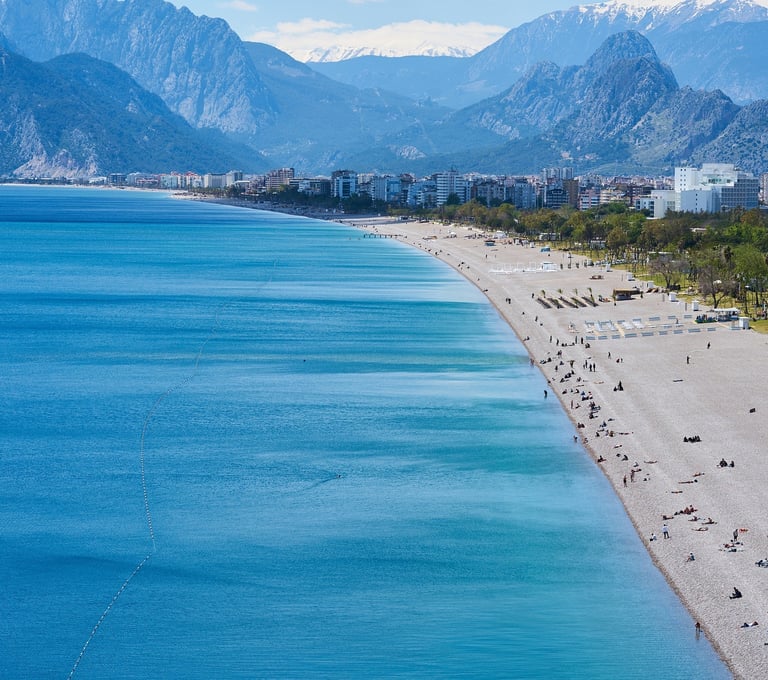
Konyaaltı Beach stretches for kilometres at the foot of the Beydağları mountains. The pebbles are smooth under your towel. The water deepens quickly — good for swimmers who want to actually swim. Behind you, the cliffs rise green and fractured. In front, nothing but sea all the way to the horizon. The cafes and promenade are there if you want them. But you can also walk until the voices fade and the only sound is the pull of shingle against the retreating wave.
Lara Beach, to the east, offers something different: fine sand, shallow water, and a skyline of resort hotels. This is where Turkey learned to do all-inclusive. The service is polished. The food is plentiful. The pools cascade down to the sea like waterfalls of their own. It is not trying to be authentic. It is trying to be effortless — and it succeeds.
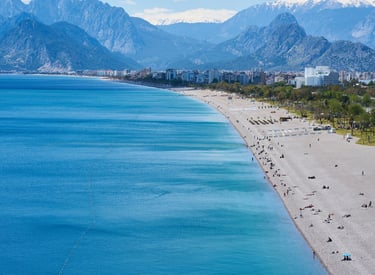
Then there is Cleopatra Beach, further south near Alanya. The sand here is so fine that legend claims it was shipped from Egypt for the queen herself. The story is almost certainly untrue. But stand at the water's edge, feel the warm shallows around your ankles, and the fiction feels less important than the feeling. Whether she waded here or not, something about this place remembers royalty.
The Old Town that Holds Time
Kaleiçi does not announce itself. You enter through a break in the walls — Roman stone, repaired by Seljuks, patched by Ottomans — and suddenly the grid of modern Antalya falls away.
The streets narrow. Cobblestones replace asphalt. Ottoman houses lean toward each other across passageways so tight that laundry lines nearly touch. Wooden shutters in faded blues and greens. Courtyards hidden behind high walls, with orange trees visible above the plaster. A cat sleeping on a doorstep. An old man sweeping dust from his threshold with movements so slow they seem deliberate.
You will get lost here. That is the point.
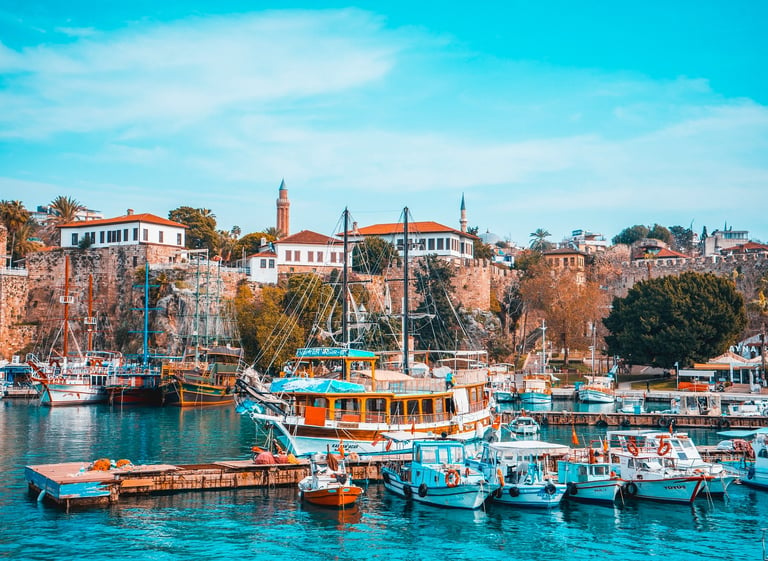
Hadrian's Gate marks one entrance — three marble arches built in 130 AD to honour the emperor's visit. The towers on either side were added later, by different rulers, in different centuries. They do not match. They do not need to. The gate has stood through earthquakes, invasions, and the construction of a shopping mall fifty metres away. It remains. So does the Roman harbour below, now filled with tourist gulets and fishing boats, but still curved in the same arc that sheltered galleys two thousand years ago.
The Antalya Museum holds what the ruins cannot. Statues from Perge with drapery so fine you can almost see the fabric shift. Sarcophagi carved with scenes of hunting and mourning. A collection of icons that survived the iconoclasts, the crusaders, and the passage of time. It is a quiet museum — cool, uncrowded, organised with the confidence of a place that knows it holds world-class things and does not need to shout about them.
For Accommodation Ideas, Explore the Map Below
The Food You Will Remember
You will eat well here. Not in the way of tasting menus and Michelin stars, but in the way of things cooked over fire and served on warm plates.
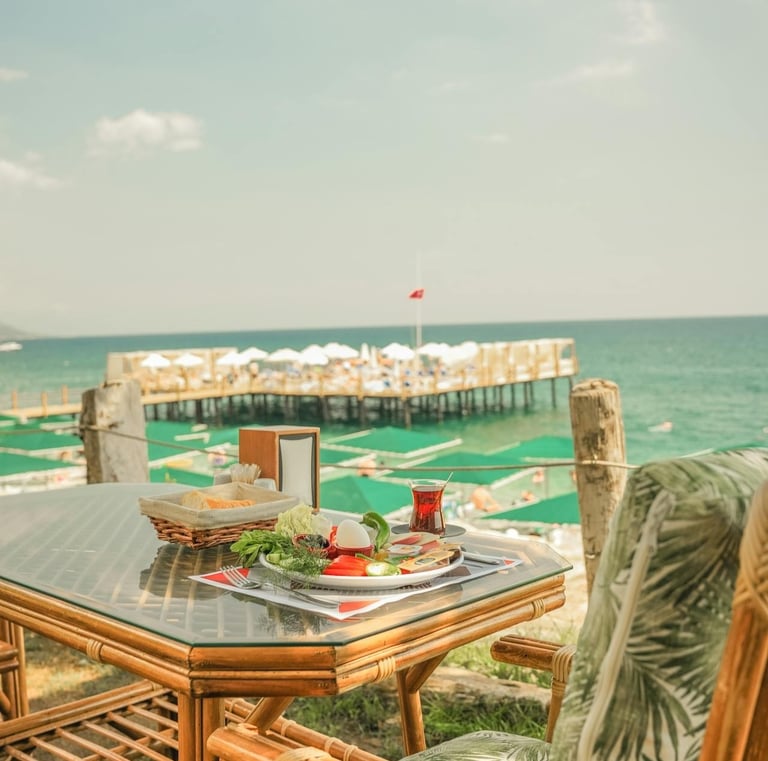
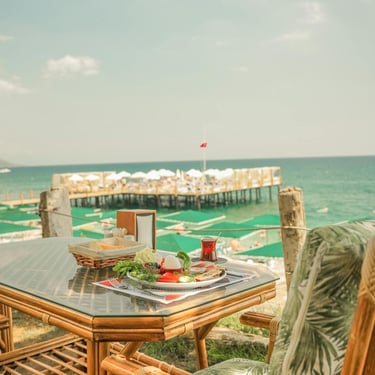
By the harbour, the fish restaurants lay out their catch on beds of crushed ice. Sea bass. Red mullet. John Dory with its dark spot still visible. You point. They grill. You eat with lemon, olive oil, and bread so fresh it tears rather than cuts. No sauces. No complications.
In the backstreets of Kaleiçi, the scent of charcoal follows you. A man turns skewers of lamb over a long trough of coals. The fat drips. The flame catches. He serves the meat wrapped in thin flatbread with tomatoes, onions, and sumac. You eat it standing, the juice running down your wrist.
Vegetarians should look for piyaz — a white bean salad from this region specifically. The beans are large and buttery. The tahini dressing is sharp with lemon and garlic. A sprinkling of parsley. A hard-boiled egg sliced on top. It sounds simple. It is simple. It is also one of the most satisfying things you will eat in Turkey.
Dondurma, the Turkish ice cream, is a performance as much as a dessert. The vendor stretches it on a long paddle. He flips it. He teases you. He hands it over with a smile. The texture is elastic — chewier than any ice cream you have known — because of salep, a flour made from wild orchid roots. The flavour is mild, milky, sometimes rose-scented. Find a stall in the old town. Stand in the sun. Let the vendor play his game. Smile back.
Beyond the City: Water and Stone
The waterfalls around Antalya are not gentle.
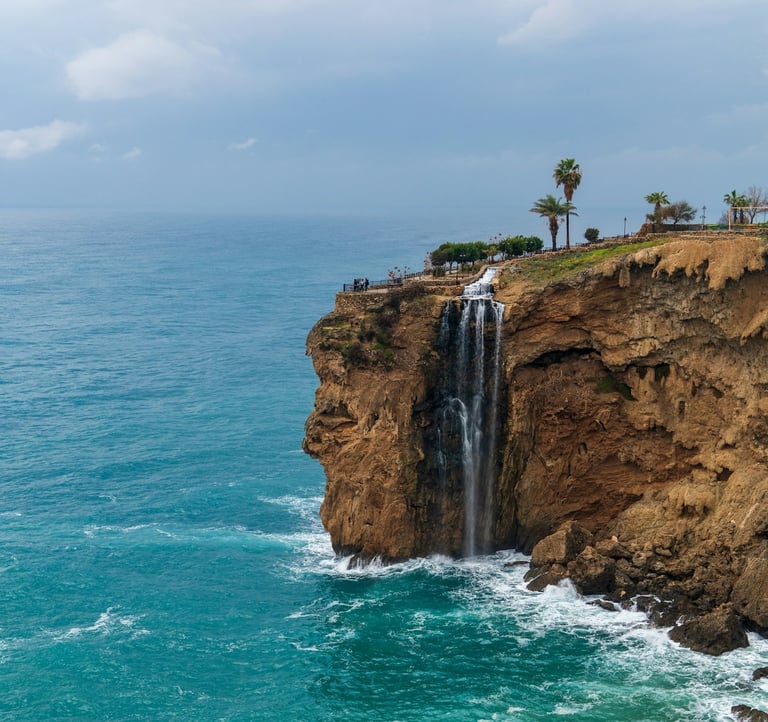
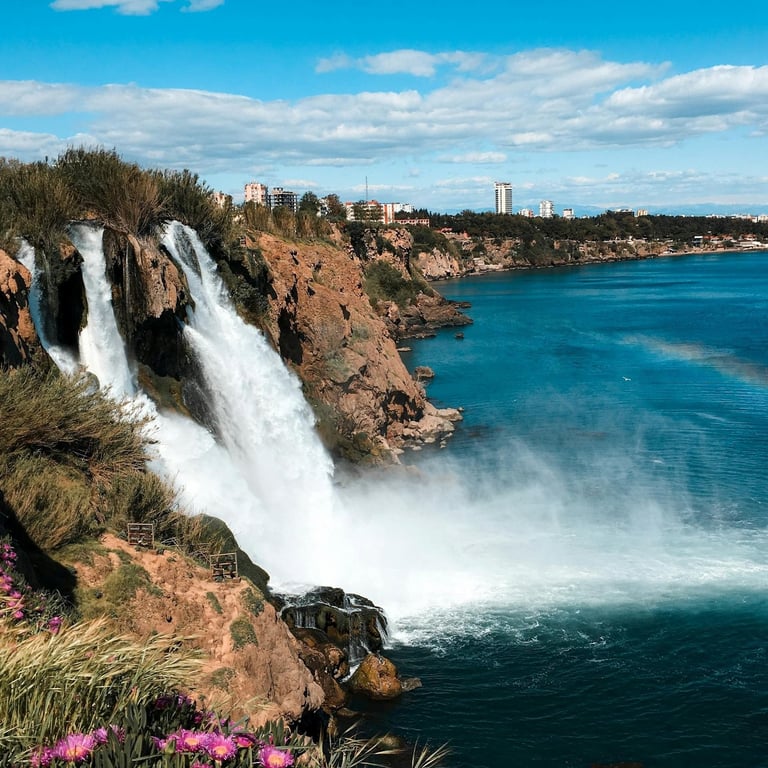
Lower Düden falls directly into the Mediterranean. The river reaches the cliff edge and simply steps off. The water hits the sea with a sound that carries for half a kilometre. You can take a boat from the harbour and approach from below, watching the cascade turn to mist before it touches the surface. Rainbows form in the spray. Disappear. Form again.
Upper Düden is different. The water drops into a pool deep in a forested park. You can walk behind the falls — into the cave worn by centuries of flow — and feel the weight of water through the rock. The air is cool. The light is green. Your voice echoes strangely, softened by the constant roar.
Kursunlu is the quietest. The falls here are smaller, tiered, almost delicate. The surrounding park is planted with pines and plane trees. Picnic tables sit in the shade. A family spreads a blanket. The children kick off their shoes and wade in the shallow pools below the cascade. No one is in a hurry. No one needs to be.
And then there is Köprülü Canyon. This is not a viewing waterfall. This is a doing place. The river has cut a gorge through the limestone so deep that the sun only reaches the bottom at midday. The rafting is real — Class II and III rapids that will soak you, spin you, and leave you laughing. Guides shout instructions. Paddles slap the water. The canyon walls rise on either side, draped in pine forest, silent and ancient. You will not think about your phone. You will not think about work. You will think only about the next drop.


Perge and Aspendos: Stone That Speaks
Perge was a wealthy city. You can tell by the columns. They line the main street in long rows, fluted marble, some still bearing their capitals. The nymphaeum — a monumental fountain — once spilled water into a canal that ran down the centre of the street. You can follow its course still. The water is long gone, but the stone channel remains.
The theatre at Perge holds 12,000 people. The stage building is two storeys high, its niches once filled with statues of gods and emperors. Most are now in museums. Their shadows remain. Stand in the centre of the orchestra, turn slowly, and imagine the roar of a crowd that has been dust for fifteen centuries.
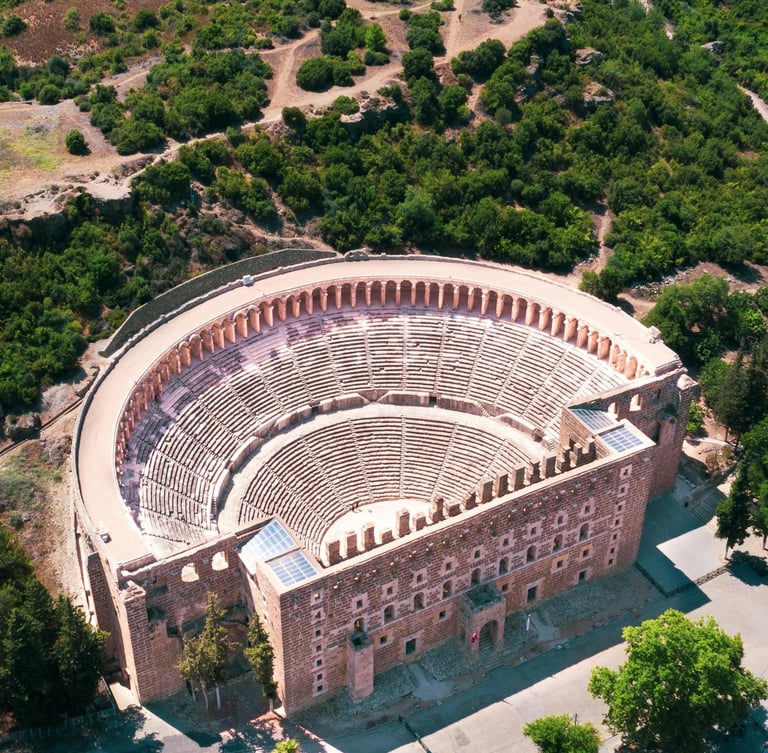
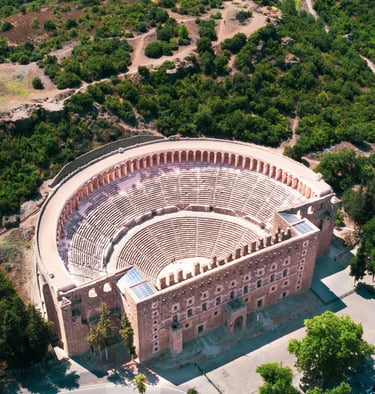
Aspendos has an even better theatre. It is the best preserved in the ancient world, and that is not hyperbole. The stage building still stands to its full height. The upper galleries are intact. The acoustics are so precise that a whisper from the stage can be heard in the back row. Every August, performances are held here. Opera. Ballet. The same voices that filled this space in Roman times, singing different songs, to different gods.
You do not need to be a historian to feel it. The stone holds something. A resonance. A memory. You walk the same steps as merchants, slaves, senators, soldiers. The sun is the same sun. The wind is the same wind. Only the names have changed.
Pamukkale and Hierapolis: A Day That Stays
One day from Antalya takes you to something that does not look like Earth.
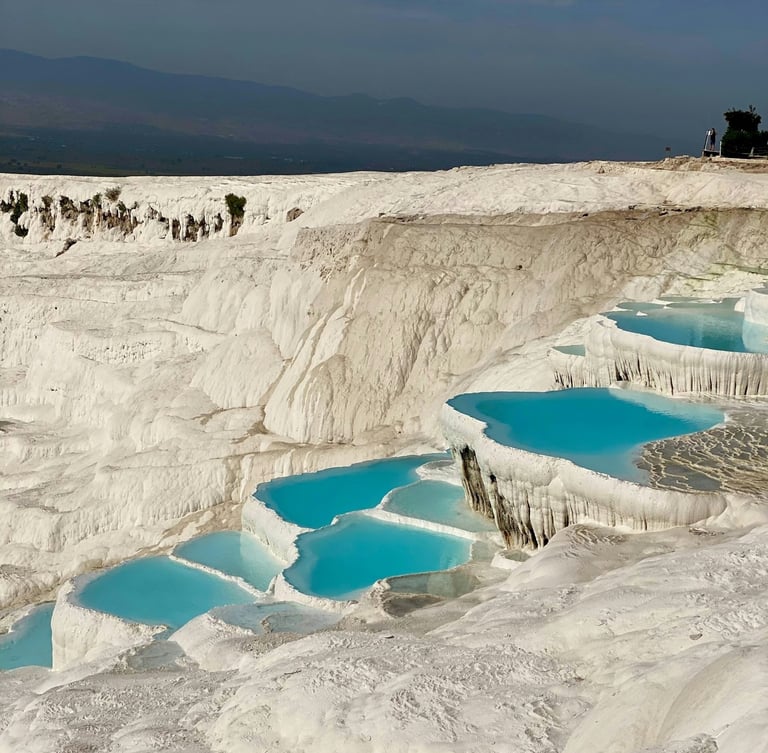
Pamukkale means "cotton castle." The name fits. White terraces cascade down the hillside, formed over millennia by hot springs rich in calcium. The water flows from pool to pool, cooling as it goes, leaving new deposits of white stone behind. The result looks like a frozen waterfall. Or a cloud. Or a wedding cake left by giants.
You walk barefoot on the terraces. Socks and shoes are forbidden — to protect the stone, yes, but also because the experience requires bare skin against warm water and smooth travertine. The pools are shallow. The water is hot. You wade from one to the next, stepping carefully on the ridges between them. Tourists take photos. But at the far end, where the crowds thin, you can find a pool to yourself. Lie back. Let the mineral water cover you. Watch the sky.
Above the terraces, Hierapolis spreads across the plateau. The ancient city was a healing centre. People came here for the hot springs, for the temple of Apollo, for the sanctuary of Pluto where toxic gases rose from a cave and priests demonstrated their power by breathing them without harm. The necropolis is the largest in Anatolia — hundreds of tombs lining the streets, from simple stone boxes to elaborate sarcophagi. It is not spooky. It is peaceful. The dead here have been dead a long time. Their memorials are weathered, softened by centuries of sun and rain.
Cleopatra's Pool is another spring, warmer and deeper than the terraces. Fallen columns lie at the bottom — granite, marble, porphyry. You swim among them. The water is buoyant with minerals. The columns are smooth from generations of hands. Whether Cleopatra actually swam here is unlikely. But the pool itself is ancient. Roman. Real. And floating in it, with the ruined columns beneath you and the white terraces glowing in the distance, history feels close enough to touch.
Sunrise from Above
If you wake early enough — before the light, before the tour buses — you can watch Pamukkale from the air.
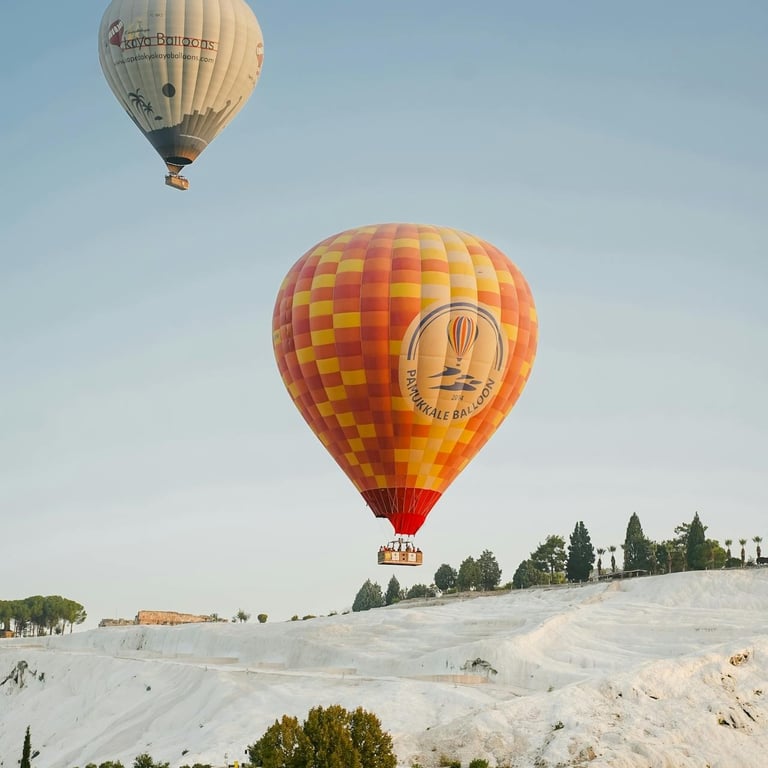
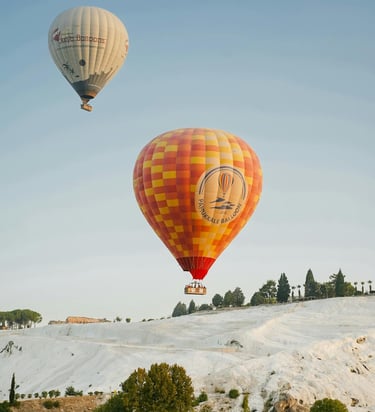
The hot air balloons lift off at dawn. The baskets carry twenty people, sometimes thirty, packed shoulder to shoulder. The burner roars. The ground falls away. And then you are floating, silent except for the occasional burst of flame, watching the white terraces turn pink in the first light.
From above, the scale becomes clear. The terraces stretch for more than a kilometre along the hillside. The ancient pool glows turquoise against the white. Hierapolis spreads its ruins across the plateau like a map of itself. And beyond it all, the plains of Phrygia roll toward the horizon, flat and hazy and endless.
The flight lasts an hour. You land in a field. There is champagne — a tradition from the early balloonists in France — and a certificate, and a toast to the morning. It is touristy. It is also beautiful. Some things are both, and that is fine.


Why Antalya Stays With You
A city with Roman gates and all-inclusive resorts should not cohere. The old and the new should clash. The beach clubs and the ruined theatres should feel like separate worlds.
In Antalya, they do not.
The sea is the same sea that carried Roman grain ships and Ottoman galleys and weekend yachts from Russia. The mountains are the same mountains that sheltered pirates and hermits and hikers with GPS. The food is the same food — grilled over charcoal, dressed with olive oil, shared among people who take their time.
Antalya does not ask you to choose between relaxation and history, between comfort and adventure. It offers both. You can spend a morning floating in Cleopatra's warm shallows and an afternoon walking Hadrian's cool arches. You can eat fresh fish by the harbour and then climb into a balloon at dawn. You can raft through a canyon and then nap on a beach.
That is the gift of this place. It meets you where you are. And when you leave, it does not let go completely.
You will find yourself remembering a particular light. A flavour. The sound of water over stone. And you will plan your return before you have even finished unpacking.
All Rights Reserved
© www.affordabletravel4u.com
Travel Info
Travel Advice